A strong portfolio does not tell you what working with a studio will actually be like. The real test begins when the first files arrive: do the assets fit the engine, follow the technical requirements, and enter your pipeline without hours of cleanup?
That is the practical side of how to choose a game art studio. You are bringing an external team into a live production pipeline, often under tight deadlines and evolving art direction. The right studio must understand both the visual goal and the production reality behind it.
Start With the Problem You Need the Studio to Solve
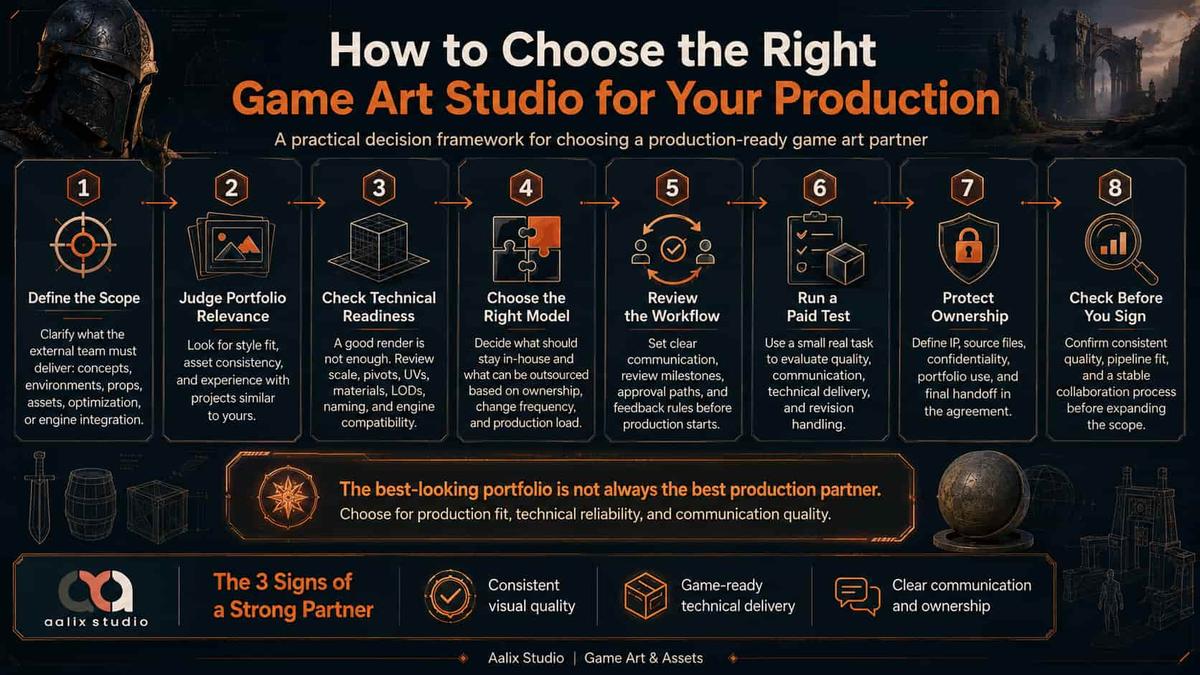
Before comparing studios, define the scope clearly. “We need environment art” is not enough. Specify whether the external team will handle concepts, blockouts, modular kits, hero assets, props, foliage, materials, optimization, engine integration, or only part of that pipeline.
Knowing how to choose a game art studio starts with knowing exactly what it must deliver. A team strong in stylized props may not suit a realistic PC title, while a concept-focused studio may lack experience with engine-ready production.
The technical brief should cover the platform, engine, polygon budgets, texture sizes, texel density, shaders, LODs, collision rules, naming conventions, source files, and review milestones. You can use Aalix Studio’s Game Art & Assets capabilities as a reference when mapping that scope.
Evaluate the Portfolio for Relevance, Not Just Impact
A portfolio should answer a production question: has this team solved problems similar to yours before?
Look at style, genre, fidelity, asset type, and scale. Realistic work does not necessarily show that a studio can reproduce a stylized visual language, and one exceptional environment does not guarantee consistent quality across dozens of assets.
The stronger signal is whether the studio can maintain the same quality bar across different artists, asset types, and review cycles.
Find Out Who Will Actually Work on Your Project
Studio size does not tell you who will handle your assets. Ask which artists and leads are assigned, who reviews the work internally, and whether the people behind the most relevant portfolio pieces are available for your project.
You are hiring the team that will work on the assets, not the studio’s total headcount.
Check Whether the Work Is Truly Game-Ready
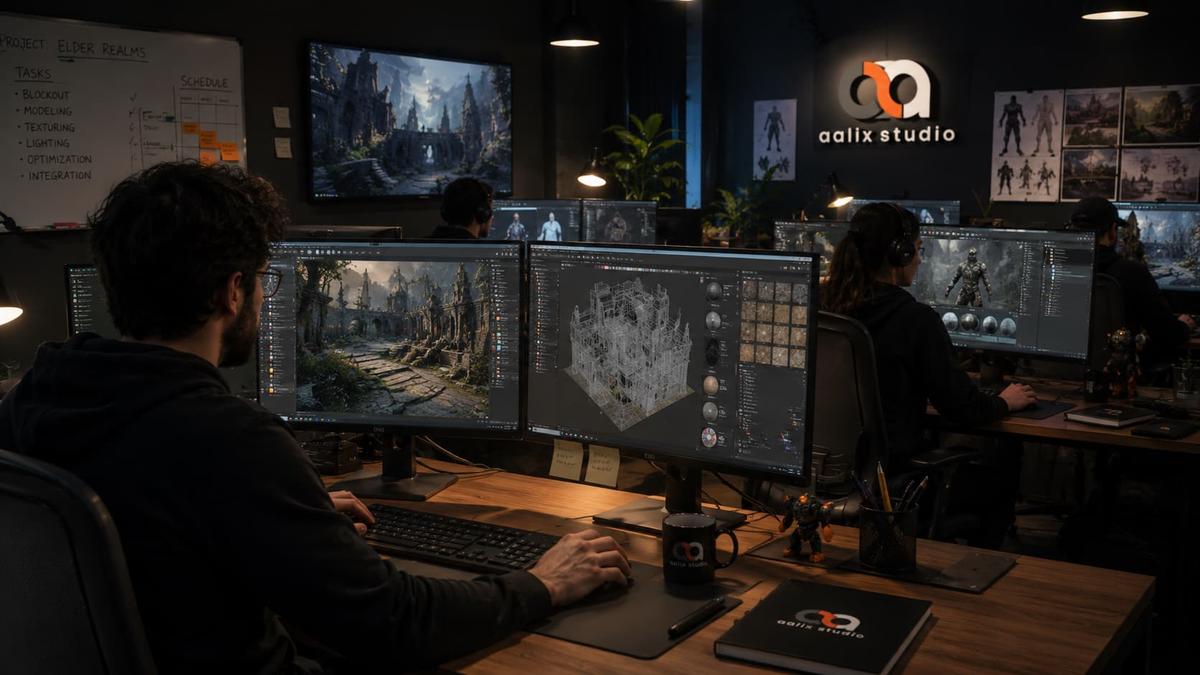
A polished render is not necessarily a production-ready game asset. When outsourcing 3D art, technical compatibility matters as much as visual quality.
Incorrect scale, poor topology, inconsistent UVs, excessive material slots, missing LODs, or messy file structures can turn a good-looking asset into extra work for the internal team.
Before production begins, confirm how the studio handles engine-specific requirements, naming, textures, collisions, LODs, exports, and source files. A reliable team should check these details before delivery, not leave them for your team to fix later.
That distinction separates strong modeling from dependable production support.
In-House vs. Outsourced Game Art: Decide Where Ownership Should Live
The choice between in-house and outsourced game art is not only about cost. It is also about deciding where creative and production ownership belongs.
Internal artists are closer to daily design changes, while external teams are useful when production volume increases, specialist skills are missing, or temporary capacity is needed.
A hybrid structure often works well: art direction, hero assets, and gameplay-critical work stay in-house, while modular assets, props, foliage, or texture production are outsourced.
Whatever the structure, each asset group should have a clear owner, a defined decision-maker, and the same technical and visual quality bar.
Treat Communication as Part of the Pipeline
Strong art can still fail inside a weak review process. In an outsourced workflow, establish who manages day-to-day communication, who gives final approval, where feedback is recorded, and how often reviews happen.
Feedback should be specific and tied to production decisions. Instead of “make it better,” identify the issue: silhouette, proportion, material, readability, or technical setup.
A clear review structure catches problems early, when they are still inexpensive to fix.
Use a Paid Test Before You Commit to Full Production
A paid test gives you evidence that a portfolio cannot.
Choose a task that closely resembles the work you actually plan to outsource, and use the same brief, technical requirements, review process, and delivery expectations planned for the full project.
Evaluate more than the final image. Did the team ask useful questions, flag risks, respond well to feedback, organize files correctly, and deliver an asset that entered the pipeline cleanly?
A strong production partner should flag risks early and explain the trade-offs before making decisions that could affect the art direction. A paid test also makes pricing easier to judge because a low quote is not truly cheaper if your internal team has to rework the files.
Protect Ownership, Security, and the Final Handoff
Before production starts, clarify ownership of final assets, source files, concepts, and any custom tools. The agreement should also cover confidentiality, portfolio usage, third-party content, and any restrictions on generative AI tools.
A dependable external partner should also make the final handoff clear: which files are included, how they are structured, whether documentation is provided, and who handles integration issues after delivery.
Three Checks Before You Sign
At this point, the decision should come from evidence rather than taste alone. Before committing to a larger scope, confirm three things during the test or first milestone:
- The team can reproduce your visual direction consistently, not just create one impressive sample.
- The delivered work fits your technical pipeline without creating a separate cleanup workflow for your internal team.
- The communication, review, ownership, and escalation process remains clear when deadlines tighten or priorities change.
If one of those areas is unstable during a small engagement, a larger scope usually magnifies it.
What the Right Partnership Looks Like in Practice
Imagine a studio producing a stylized action game. Its internal art director owns the visual direction, but production suddenly needs dozens of props, modular architecture pieces, foliage assets, and secondary environments. Hiring permanently for a temporary production peak may not make sense.
Instead, the studio prepares a quality bar and technical guide, shortlists an external team, and commissions a paid modular-kit test using the same review path planned for the full project. Both the assets and the team’s response to feedback are evaluated.
Once the assets match the style and integrate cleanly and the external team has shown that it can respond to feedback without creating unnecessary friction the scope expands. At that point, game art outsourcing is doing exactly what it should: adding production capacity while fast-moving creative decisions stay with the internal team.
When reviewing a studio, compare promises with actual project evidence. Aalix Studio’s selected work provides another internal reference point for that comparison.
Choose for Production Fit, Not Portfolio Alone
In the end, the right choice comes down to one thing: whether the team fits the way your game is actually being produced. Portfolio quality is only the first filter. The studio still has to maintain quality, follow technical requirements, communicate clearly, handle feedback, and deliver work your team can actually use.
A game art production partner earns that role by fitting into the production process, not just by delivering files at the end of it. Game art outsourcing works best when the external team is treated as part of the production system, with clear responsibilities and shared standards, rather than as a separate asset factory.
Game Art Studio Selection FAQ
How do I choose a game art studio?
Look beyond the portfolio. Evaluate relevant experience, technical readiness, communication, team structure, workflow, and whether delivered assets fit your production pipeline.
When does game art outsourcing make sense?
It works well when production volume increases, specialist skills are missing, or the internal team needs additional capacity without permanent hiring.
What should I check when outsourcing 3D art?
Check scale, topology, UVs, textures, LODs, collisions, naming conventions, folder structure, engine compatibility, and source-file delivery.
Should I request a paid test?
Yes. A small paid test shows how the studio interprets the brief, handles feedback, communicates production risks, and delivers production-ready files before you commit to a larger scope.
If you have a defined need for 3D assets, garments, materials, surfaces, or Unreal Engine validation, you can start a game project with Aalix Studio.