A finished creative project can look deceptively simple from the outside A website launches, a brand identity is revealed, or a garment concept is presented but most of the decisions that shaped the final result happened long before that moment.
The creative project process connects the first conversation with the final handoff through research, direction, development, review, refinement, and delivery. Its purpose is not to make creative work rigid, but to help teams resolve important questions before they become expensive problems.
Following a project from design brief to delivery also shows how much of the real work happens before the final visuals begin to take shape.
What Is a Creative Project Process?
A creative project process is the structure a team uses to move from an initial idea or problem to a finished piece of work that can be used in the real world.
The exact stages may differ across branding, web design, fashion, and 3D production, but the underlying logic is similar: clarify the problem, explore possible directions, develop the work, review it, refine it, and prepare it for delivery.
Creative projects rarely begin with every question answered. A strong creative workflow gives the team a way to deal with uncertainty step by step instead of forcing every decision too early.
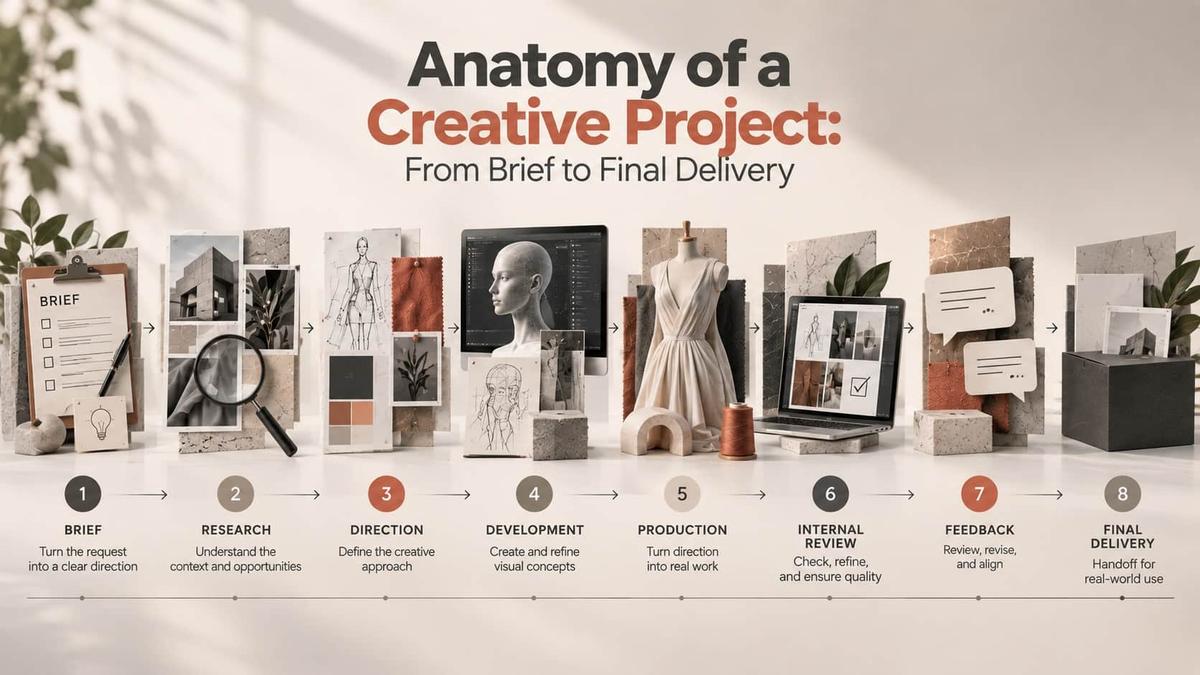
Stage 1: Turning the Request Into a Useful Brief
Many creative projects begin with requests that sound clear but are still too broad to guide the work. “We need a new website” or “we want a stronger brand” describes an output, but not necessarily the problem behind it.
Before design begins, the team needs to understand what is driving the request and what the final work is expected to achieve.
From Client Input to Design Criteria
The path from design brief to delivery becomes easier to manage when client input is translated into criteria that can be tested. If a company wants to appear more credible to enterprise buyers, that goal may affect hierarchy, typography, messaging, imagery, and the overall tone of the experience.
A useful brief should clarify the problem, audience, scope, timeline, decision-makers, and approval process before detailed design work begins.
Stage 2: Research Before Creation
Research gives the team context before creative decisions become expensive to reverse.
Depending on the project, that may mean studying the audience, competitors, technical limitations, existing content, user behavior, or assumptions in the original brief.
The goal is not to collect information for its own sake. Research should help the team decide what matters, what needs to change, and which directions are worth exploring.
In a Digital Design project, those findings might affect the site structure, page hierarchy, content priorities, or visual direction before detailed interface work begins.
Stage 3: Defining the Creative Direction
Research becomes useful when it starts shaping real creative choices.
At this stage, the team may compare visual directions, test early layouts, explore references, or decide which ideas are strong enough to move forward.
Feedback should stay focused on the direction itself. Does the tone fit the audience? Does the hierarchy make sense? Does the idea support the goal defined in the brief?
The purpose is not to perfect the final design yet. It is to agree on a direction before more time is invested in detailed development.
Stage 4: Developing Concepts Without Endless Options
Once a direction is approved, the team needs something tangible to test. Depending on the project, that might be a layout, sketch, prototype, garment concept, identity route, or early 3D study.
This is where the creative workflow becomes more visible, but more options do not always lead to better decisions. Too many variations can make feedback less focused and pull attention away from the original brief.
The goal is to develop enough material to test the direction properly without creating unnecessary alternatives.
In Fashion & Apparel, for example, a sketch may look convincing on paper but still need to be tested against silhouette, material, construction, and presentation before it can move forward.
Stage 5: Moving From Direction Into Production
Once the direction is approved, the project moves into production and the number of detailed decisions increases quickly.
Production looks different across disciplines. A website has to work across screen sizes and interactions, a brand direction expands into a usable identity system, fashion introduces material and construction decisions, and 3D work moves deeper into modeling, surfacing, and technical preparation.
This is often the stage clients recognize as “the design,” but it is also where unresolved decisions from earlier stages become more visible.
The clearer the brief and direction are before production begins, the less time the team has to spend correcting avoidable problems later.
Stage 6: Internal Review Before Client Review
Before the work reaches the client, it should go through an internal review.
A fresh set of eyes can catch inconsistencies, missing details, weak decisions, or technical issues that are easy to overlook after spending too much time on the same work.
The review should return to the brief: does the work still solve the problem the team agreed to address, and is it ready to be presented clearly?
Internal review is not about adding more opinions. It is about catching avoidable problems before they become part of the client feedback cycle.
Stage 7: Feedback, Revisions, and Scope
Feedback is most useful when it explains the reason behind a reaction. “This feels too formal for the audience we discussed” gives the team something specific to investigate. “I don’t like it” does not.
Personal taste will always play some role, but useful feedback should connect back to the audience, objective, usability, or direction defined in the brief.
The brief also helps separate a revision from a scope change. Adjusting typography within an approved website concept is a revision. Adding an online shop halfway through the project changes the scope because it introduces new requirements, functionality, and production work.
Making that distinction early helps protect both the timeline and the quality of the final result.
Stage 8: Finalization and Handoff
Approval does not automatically mean the project is ready to hand off.
Before delivery, the team needs to check how the work performs in the environment where it will actually be used. For a website, that may include responsive behavior, browser testing, and final content checks. A brand project may require clean file organization, export formats, and usage guidance. In Game Art & 3D, it can mean validating materials, assets, and technical setup inside the intended real-time environment.
Final delivery should make the next step easy. Files need to be organized, clearly named, and usable without requiring the designer to explain every detail afterward.
A successful handoff is not just about sending files. It is about leaving the client or production team with work they can confidently use and continue.
Where Creative Projects Usually Break Down
Creative projects usually break down when important questions are left unresolved until too late.
Three problems appear especially often:
- An unclear brief leaves different people working toward different definitions of success.
- Fragmented feedback creates contradictory revisions and makes approval harder to track.
- Late scope changes force the team to revisit decisions after dependent work has already been completed.
Change is normal in creative work. The problem is not that a project evolves; it is that a major change is discovered only after other parts of the work already depend on earlier decisions.
A Project Case Study: When a Website Request Reveals a Larger Problem
Imagine a growing company that approaches a studio because its website feels outdated. The obvious response would be to redesign the pages.
But early discovery reveals a larger issue: the company has expanded its services, shifted toward a different type of client, and never updated its visual identity or information structure to match.
This is where a useful project case study becomes more than a before-and-after. The initial request is a website redesign, but the real problem is broader positioning and identity.
Instead of jumping straight into layouts, the team revisits the company’s positioning, reorganizes the content, updates the identity direction, and only then begins the website design.
Identifying that mismatch early prevents the studio from redesigning pages around a problem that has not actually been solved. A disciplined creative project process helps redefine the project before most of the budget and production effort are committed.
A strong project case study should explain decisions like these, not just display the final screens.
How a Design Studio Works Behind the Final Result
Client presentations show only a small part of what happens inside a studio.
Understanding how a design studio works means looking at the work between those presentations: internal critique, coordination between specialists, version control, technical checks, and the small decisions that keep the project moving in the same direction.
Those decisions are connected. A change in brand direction can affect the interface, while a technical limitation may force the team to rethink a visual idea.
Good studio work depends on managing those connections without losing sight of the original brief.


What a Strong Creative Project Process Produces
A strong creative project process does not eliminate change. It gives the team a clear way to respond when new information appears.
Designers still have room to explore, but they are not starting from zero at every review. The brief, approved direction, and earlier decisions create a shared reference point for judging what should change and what should stay.
Clients also know when their feedback matters most and when a new request may affect the scope, timeline, or production work.
The result is less time spent correcting avoidable problems and more time spent improving the work for the right reasons.
From Brief to Final Delivery
The path from design brief to delivery is rarely perfectly linear. Research can change the brief, testing may reveal a better solution, and client feedback can send part of the work back for another round of refinement.
Returning to an earlier stage is not a failure when new information justifies it. The important thing is that each change has a clear reason and that the team understands what the change affects.
In multidisciplinary work, one decision can easily influence another. A shift in brand direction may affect the website, while a technical limitation can change how a 3D or digital idea is executed.
The final output is what people see, but the process determines whether that output is actually useful.
A good creative workflow provides enough structure to keep decisions clear without shutting down exploration too early. By the time the project reaches final delivery, the work should be organized, usable, technically ready, and clear enough for the client or production team to move forward with confidence.
Creative Project Process FAQ
What is a creative project process?
It is the structured path that moves an idea from the initial brief through research, creative direction, development, review, refinement, and final delivery.
Why is the design brief important?
A clear brief defines the problem, audience, scope, timeline, decision-makers, and approval process before detailed design work begins.
How does research affect a creative project?
Research helps the team understand the audience, competitors, technical limits, and assumptions before choosing a creative direction.
What is the difference between a revision and a scope change?
A revision improves work within the approved direction. A scope change introduces new requirements, deliverables, or functionality beyond the original agreement.
What makes final delivery successful?
The finished work should be organized, usable, technically ready, and clear enough for the client or production team to continue confidently.