For centuries, clothing worn at important gatherings has carried meaning beyond appearance. It has signaled rank, tradition, belonging, ceremony, and sometimes resistance. The meaning attached to clothing has changed, but it has never really disappeared.
Today, a red carpet, concert stage, wedding, gala, or themed event can turn a garment into part of a public message. Fit still matters, but the designer also has to understand what the wearer wants the garment to communicate through silhouette, material, movement, proportion, and detail.
Before sketching, it helps to ask: what should people understand about the wearer before a word is spoken?
What Is Custom Eventwear Design?
Good custom eventwear design starts with context, long before embellishment enters the conversation. Who is wearing the piece? Where will it be seen? Will the wearer sit through dinner, walk a carpet, perform under stage lighting, or move continuously for several hours?
Those conditions shape the design. A dramatic train may work for an entrance but fail onstage. Delicate embroidery can disappear in a large venue. A fitted bodice may create the intended silhouette yet become a problem if it restricts movement.
What makes the work truly custom is the way those decisions respond to the same wearer, event, and purpose.
Custom, Made-to-Measure, Bespoke, and Made-to-Order
These terms describe different levels of intervention.
A made-to-measure gown usually begins with an established design or base pattern that is adjusted to the client’s measurements and proportions. The garment is adapted to the wearer rather than developed entirely from scratch.
A bespoke evening dress takes a more individual approach. The wearer, event, design concept, and personal proportions can all shape the pattern, construction, and fitting process from the beginning.
Made-to-order is different: an existing design is produced after ordering, sometimes with limited choices in color, fabric, or finish. Because “custom” can cover several approaches, clients should ask what level of customization is actually included.
When Does Custom Eventwear Make Sense?
Not every occasion needs a one-off garment. Ready-to-wear may be smarter when time is short or an existing silhouette already works well.
Custom eventwear design becomes especially valuable when an event has a strong visual brief, standard sizing does not work for the wearer, or the garment has to meet several practical and creative requirements at once.
Before commissioning a piece, clarify three things:
- The event: date, venue, dress code, expected movement, lighting, weather, and how close the audience will be.
- The wearer: personal taste, proportions, comfort boundaries, preferred and disliked details, and how much attention the garment should attract.
- The purpose: whether the priority is elegance, symbolism, performance, cultural reference, visual impact, or a balance between them.
Those answers often tell a designer more than a large folder of references.
The Custom Dress Process: From Idea to Garment
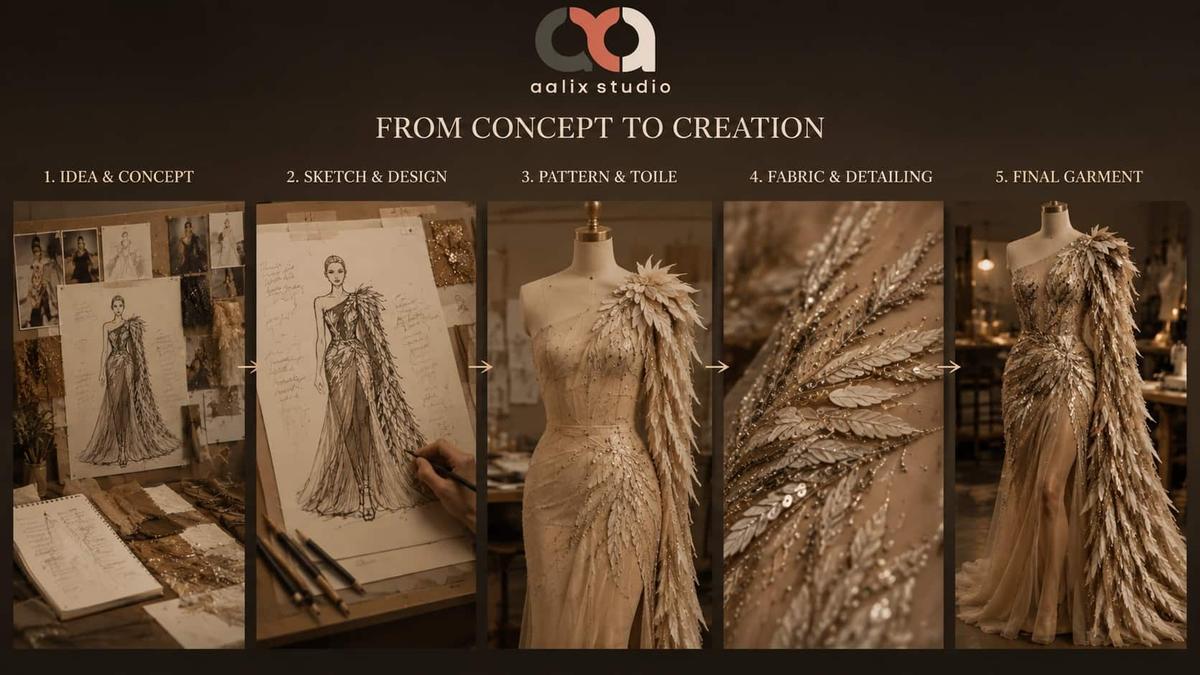
The custom dress process begins before the first serious sketch. In a custom eventwear design project, the designer first has to decide which ideas are essential and which can evolve as the garment develops. Otherwise, references can start competing instead of forming a coherent design.

Step 1: Consultation and Design Direction
The consultation establishes the event, visual intention, practical constraints, and emotional tone. References work best when the client explains what they respond to rather than asking for a replica.
Step 2: Measurements and Proportion
Measurements are only the starting point of fit. Posture, torso length, waist placement, and overall balance determine how the garment will actually sit on the body.
Step 3: Fabric, Pattern, and Toile
Fabric affects structure as much as appearance. Satin catches light differently from crepe; organza creates volume differently from tulle. A toile can test proportion before the final fabric is cut.
For a closer look at how an idea develops from concept toward a finished garment, see Aalix Studio’s fashion design process.
Step 4: Fittings and Refinement
The fitting is where decisions made on paper meet the wearer’s movement and proportions. This part of the custom dress process tests balance, support, drape, and mobility.
What Happens During a Made-to-Measure Fitting?
A fitting for a made-to-measure gown should reproduce real wearing conditions as closely as possible. Shoes affect hem length and posture. Underlayers can change how a bodice sits. Movement may reveal tension that standing still does not.
Clients should bring the intended shoes, planned underwear or support garments, and relevant accessories. A fitting is primarily technical. It shows what happens to the garment when the actual wearer stands, walks, turns, and moves in it.
Custom Dress Timeline: How Long Does a Custom Dress Take?
There is no single timeline for every custom dress. A custom dress timeline depends on complexity, material sourcing, pattern development, handwork, fittings, revisions, and the studio’s schedule.
A useful custom dress timeline is built backward from the event date. Experimental silhouettes, specialist fabrics, embroidery, and difficult construction need more room for testing and correction.
Starting early leaves room to test and refine ideas instead of making design decisions simply because the event date is getting too close.
What Affects the Cost of a Bespoke Dress?
The price of a bespoke evening dress includes more than fabric and sewing time. A one-off garment may require concept development, original pattern work, toile construction, hand finishing, fittings, and revisions.
Even a visually simple dress can demand great precision because clean lines expose problems in fit and finishing.
Aalix Studio’s fashion and apparel services show how concept development, technical design, and custom work connect within a broader fashion design process.
A Practical Example: Designing for a Concert in Japan
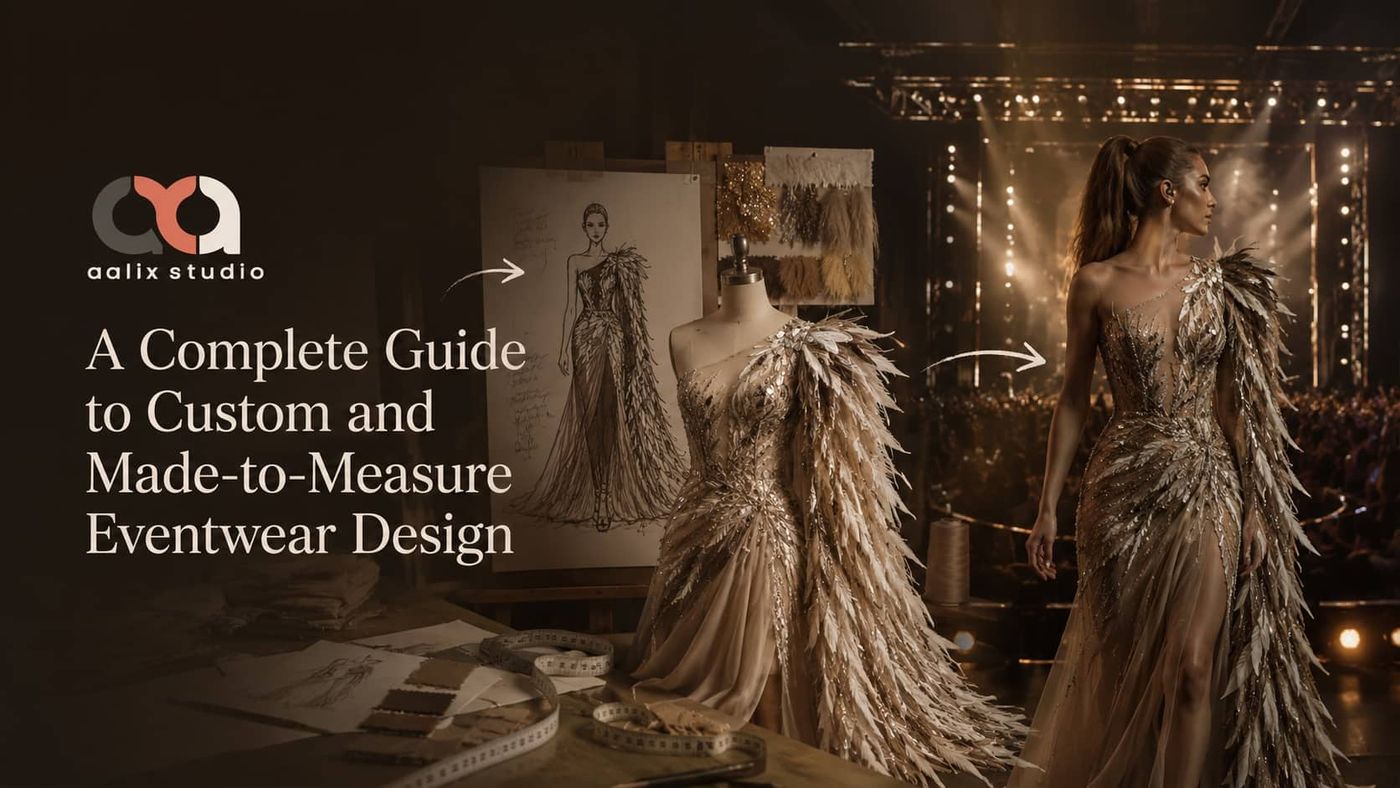
Imagine a fictional American pop artist preparing for an outdoor concert in Japan. Her performance is highly physical, and one song uses the hawk as a metaphor for freedom and independence, asking the audience to see the individual as human before defining them by gender.
For a project like this, custom eventwear design has to interpret the performance, not simply decorate the performer.
The most literal solution would be to reproduce a hawk, but that could push the idea toward costume. A more nuanced direction would translate qualities such as flight, asymmetry, movement, and reflection.
One side of the body could remain visibly human beneath a close-fitting, shimmering base layer, while the other develops into an abstract wing. Reflective elements could catch the stage light, while feather-like textures would shift visibly as the performer moves. Any cultural reference to Japan should remain restrained.
At that point, the design has to work as a performance garment, not only as an illustration. The silhouette must remain readable from a distance, the performer must be able to move freely, and the visual language still has to support the song.
Custom Eventwear vs. Ready-to-Wear
The right choice depends on what the client needs from the garment.
Ready-to-wear begins with a finished design. A made-to-measure gown usually retains an existing design or base pattern while adapting its measurements and proportions to the wearer. Fully custom work can reverse the order by beginning with the wearer, occasion, and concept.
A well-fitted garment is not necessarily custom. An altered ready-to-wear dress may fit beautifully, while a conceptual oversized piece may be fully custom without following the body closely.
Common Mistakes to Avoid
A project can have dozens of good references and still lose direction if no one decides which ideas matter most.
Common mistakes include starting too late, choosing details in isolation, and treating a front-view sketch as the whole garment. Eventwear also has to work from the back and side, in motion, and under changing light.
A disciplined custom dress process keeps returning to the project’s central priority instead of treating every new idea as equally important.
How to Prepare for Your First Custom Dress Consultation
You do not need to arrive with a finished design. Fixing every detail beforehand can leave little room for the designer to solve problems or find a stronger direction.
Bring the event date, a few useful references, comfort preferences, and clear information about how the garment will be used. Explain what you like about each reference, such as the silhouette, fabric, proportion, mood, or movement, instead of simply asking for a copy.
This is also the right moment to discuss the custom dress timeline, expected fittings, material limits, and what changes remain possible once pattern development or construction has begun.
Final Thoughts: A Better Dress Starts With a Better Question
Clothing is often one of the first things we notice about someone, which means it can communicate something about the wearer before we know anything else about them. That is not limited to celebrities or public figures; a private client can also use eventwear to express identity, memory, celebration, or restraint.
This is where custom eventwear design becomes more than a question of personalization. The strongest custom eventwear design considers not only measurements, but also the wearer, the event, the movement required, and the idea the garment is meant to carry.
When developing a bespoke evening dress, priorities should be clear before embellishment is considered. The designer has to decide what deserves emphasis, what the garment should communicate, and how freely the wearer needs to move.
If you are considering a one-off garment, start by defining its purpose, where it will be worn, and how much time is available before the event. From there, the designer can translate an idea into a garment that belongs to that particular wearer and that particular occasion.
Custom Eventwear Design FAQ
What is custom eventwear design?
It is a design approach built around the wearer, event, movement, proportions, and visual purpose rather than simply altering an existing dress.
How is a made-to-measure gown different?
A made-to-measure gown usually adapts an existing design or base pattern to the client’s measurements and proportions.
What makes a bespoke evening dress different?
A bespoke evening dress can begin from the client, event, concept, and individual proportions, with the pattern developed specifically for that project.
How long does the process take?
The custom dress timeline depends on complexity, fabric sourcing, fittings, handwork, revisions, and the event date.
What should I bring to a custom dress consultation?
Bring the event details, a few useful references, comfort preferences, intended shoes, and clear information about how the garment will be worn.
To discuss a custom eventwear design project, contact Aalix Studio.