
A design can survive one review. What often weakens it is a series of disconnected requests: move a message higher, emphasize another action, soften a distinctive choice. After several rounds, the design may still look polished but lose the logic that made it coherent.
Learning how to give design feedback means preventing that drift. Reviewers need to explain what is not working and why it matters, while designers need enough room to solve the problem.
Good feedback protects the reasoning behind a concept without treating the first version as untouchable. When new evidence, business requirements, or technical constraints change the problem, the design should be allowed to change with it.
Start the Review With Design Intent
A useful review starts before anyone opens the comment panel.
The team should agree on the audience, primary action, business purpose, brand qualities, and key constraints. These decisions become the criteria for evaluating the work.
Without that shared reference, personal preference can easily become direction.
The wider creative project process moves from brief and research through production and delivery. During review, those earlier decisions should remain visible so feedback can focus on whether the design is doing its intended job.
Separate Objectives, Needs, Requirements, and Preferences
Not all feedback carries the same weight.
A design review may include user needs, brand requirements, business requirements, technical constraints, and personal preferences. These inputs can all matter, but they should not be treated as equally authoritative.
A payment rule requiring specific language is different from a preference for shorter copy. Evidence that users miss the primary action should outweigh someone’s favorite color. At the same time, clients may hold useful information that was never captured in the brief.
Knowing how to give design feedback starts with one question: what project condition does this comment relate to?
If the answer is unclear, clarify it before turning the comment into a revision request.
Identify the Problem Before Suggesting the Fix
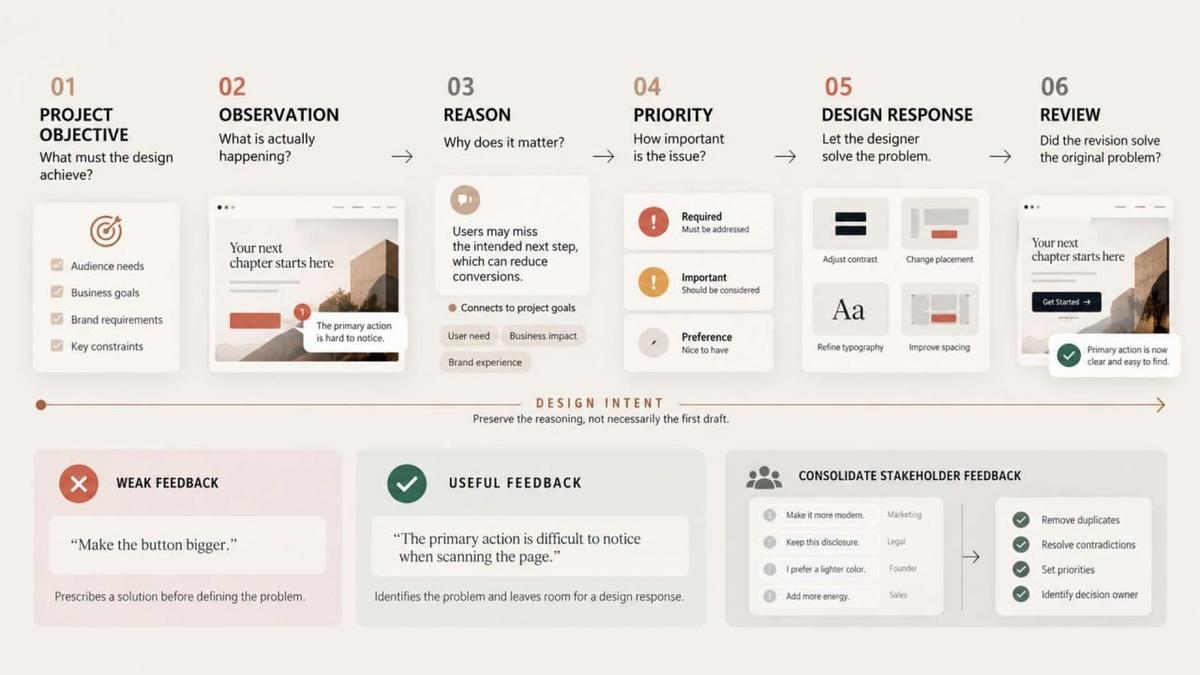
“Make the button bigger” sounds specific, but it may describe a solution before the real problem is understood.
The primary action might be difficult to notice while scanning. Size could help, but contrast, placement, wording, spacing, or nearby competition may solve the issue more effectively.
Design choices work in relationships. Strengthening one element can weaken another, and adding information can reduce clarity.
Useful feedback should therefore describe the problem first and leave room for the designer to choose the most appropriate response.
Translate Reactions Into Useful Observations
Reviewers do not need specialist vocabulary to give constructive design critique. They do need to explain what they observed and why it matters.
“The homepage feels flat” becomes useful when the reviewer identifies what is missing: weak hierarchy, repetitive pacing, unclear priorities, or imagery that conflicts with the brand.
The same applies to identity work. “Make the logo more modern” gives no clear standard for success. “The fine details disappear in small digital applications” gives the designer a specific problem to investigate.
A useful comment should answer three questions:
- What did I observe?
- Why does it matter to the audience, objective, requirement, or production context?
- How important is it compared with the other issues in this review?
State Direct Requirements When They Really Are Requirements
The problem-first principle is not absolute.
Clients, developers, legal reviewers, or other stakeholders may hold information the designer cannot infer from the interface alone. Terminology may be fixed, a component may have a technical limit, or a regional audience may interpret imagery differently.
In these cases, client feedback for designers should state the requirement and its source clearly.
For example: “Keep this disclosure because it is the approved contractual wording.”
That tells the designer what cannot change while still leaving room to improve placement, hierarchy, or presentation.
Manage Stakeholder Feedback Before It Reaches Production
Collecting every comment is not the same as making a decision.
Separate reviews can produce conflicting instructions: make the identity more restrained, add more energy, increase every message, and simplify the composition.
A sound design revision process requires the client team to resolve those contradictions before asking for another version.
Disagreement is normal. Passing it unresolved into production shifts a business decision onto the designer and often creates unnecessary revision cycles.
Consolidate the Response, Not Just the Comments
One review space should contain the approved response, not a transcript of every internal discussion.
Duplicate comments should be removed, contradictions resolved, and questions separated from decisions. This gives the designer a coherent set of issues to address instead of competing instructions.
Decision ownership should also be clear. A brand lead may own identity direction, a product manager may own feature priority, and legal counsel may own compliance wording.
Priority should reflect consequence, not seniority or volume. Accessibility barriers, comprehension problems, and fixed requirements should outweigh minor preferences.
Clear client feedback for designers distinguishes required changes, useful exploration, and optional preferences.


Preserve the Design Logic Across Revisions
A concept is rarely diluted by one dramatic change. More often, it weakens through a series of isolated edits that are approved without checking what they affect.
Enlarging a headline may reduce space for supporting information. Adding navigation choices can change mobile behavior. Replacing a typeface may affect readability, language support, or brand tone.
In Digital Design and Branding, identity, hierarchy, interface behavior, and communication assets need to reinforce one another. A local improvement can create a larger inconsistency if those elements stop working as a system.
Before approving a revision, check what the change improves and what it may disturb elsewhere.
Protect the Reasoning, Not the First Draft
Before approving a change, ask what depends on the affected element. Could the request weaken hierarchy, create an exception the wider system must repeat, or reverse an earlier decision without new evidence?
A simple decision record helps preserve that reasoning. The design revision process does not need notes about every detail, but it should capture decisions that affect the wider system.
Protecting design intent does not make the first concept untouchable. Research, usability findings, technical constraints, or production limits may reveal that an earlier assumption was wrong.
Constructive design critique should identify the evidence, name the assumption that changed, and decide whether the work needs a focused revision or a different direction.
Turn Raw Comments Into Design Decisions
A useful workflow connects the project objective, observation, reason, priority, design response, and review. This is how to give design feedback without turning collaboration into a list of requested edits.
Consider a pricing page that feels confusing. Reviewers identify the real issues: every feature has equal weight, plan differences are hard to scan, and the recommended option is unclear.
The objective is to help qualified buyers compare plans quickly.
Instead of asking for “bigger boxes,” the team asks the designer to improve comparison. The response may group shared features, clarify differences, and reduce the prominence of secondary details.
The next review should test whether comparison is easiernot simply whether the layout changed.

Close Each Round With a Clear Record
At the end of each review, record what was accepted, rejected, deferred, or identified as a scope change. Decisions that affect the wider system should also include a brief reason.
This keeps the design revision process consistent without making it rigid. New stakeholders can understand earlier decisions without reopening the same discussions.
Knowing how to give design feedback also means checking the revision against the original concern. If visibility was the problem, test visibility. If credibility was the concern, review composition, language, and imagery together.
The GTOA branding project involved multiple audiences, so changes made for one application still had to remain coherent across the wider identity.
When Designers Should Push Back
Designers should question a request when the problem is unclear, the proposed edit conflicts with an approved objective, or a local change may damage the wider system.
Professional pushback should explain the consequence. For example: “Giving all three actions equal emphasis will remove the intended priority. Which action matters most?”
The designer can recommend an alternative and explain the tradeoff, but pushback should not become personal ownership of the work. An authorized decision-maker may still choose a different direction.
Good client feedback for designers makes this easier because the business reason behind the request is visible.
The principle works both ways. Knowing how to give design feedback helps clients avoid accidental design decisions, while designers can use feedback to uncover information that may have been missing from the brief.
Final Thoughts
Before requesting a change, ask: “What problem are we trying to solve, and does this change strengthen or weaken the original objective?”
Knowing how to give design feedback does not mean protecting weak ideas or resisting change. It means giving each revision a clear reason.
A concept can evolve substantially when the team learns something important. What weakens it is not change itself, but a sequence of disconnected preferences that no one evaluates against the original objective.
Frequently Asked Questions
What makes design feedback useful?
Useful feedback identifies the problem, explains why it matters, and connects it to the project objective. It should give the designer enough context to respond without prescribing the solution too early.
Should clients suggest design changes?
Yes, when the request reflects a business requirement, technical constraint, legal rule, or audience insight. When possible, describing the underlying problem usually gives the designer more room to find the strongest solution.
How should conflicting stakeholder comments be handled?
Consolidate comments before sending them to the designer. Resolve contradictions, remove duplicates, assign priorities, and confirm who owns the final decision.
When should the original concept change?
The concept should change when research, usability findings, technical constraints, or production limits reveal that an earlier assumption was wrong.