A pair of trousers can look right while standing and still pull across the seat when the wearer sits. If the supplier needs approval before grading begins, a simple yes or no is not enough. Approving the appearance leaves the movement problem unresolved; rejecting the whole garment discards work that may already be correct.
Understanding clothing sample types helps brands make narrower, more useful decisions. Each sample should test specific properties under defined conditions. Good garment sample approval records what the garment has demonstrated, what remains open, and whether the next manufacturing step can proceed.
Decide What the Sample Needs to Prove
Sample names vary between suppliers and brands. A prototype may also be called a development sample or first fit, while a sealed sample usually refers to an identifiable approved reference rather than a mandatory stage for every garment. Before ordering anything, agree on what the supplier will submit, which materials and sizes it will use, what the review will assess, and what approval will allow the team to do next.
Plan clothing sample types around the development risks that still need evidence. Aalix's fashion design and digital fashion expertise connects design, patterns, specifications, and digital development. The sampling plan should make clear which inputs are settled and which are still being tested, with enough review time before cutting or other commitments make changes expensive. Not every project needs every available sample.
Use Early Samples to Resolve Design and Base Fit
Early samples make unresolved design choices visible. A convincing silhouette can hide awkward construction, unsuitable material assumptions, or a fit problem that appears only in movement. Before a fitting, the reviewer should know whether the garment represents the intended design in representative material or is still an exploration with major decisions open.
Prototype: Test the Design's Physical Interpretation
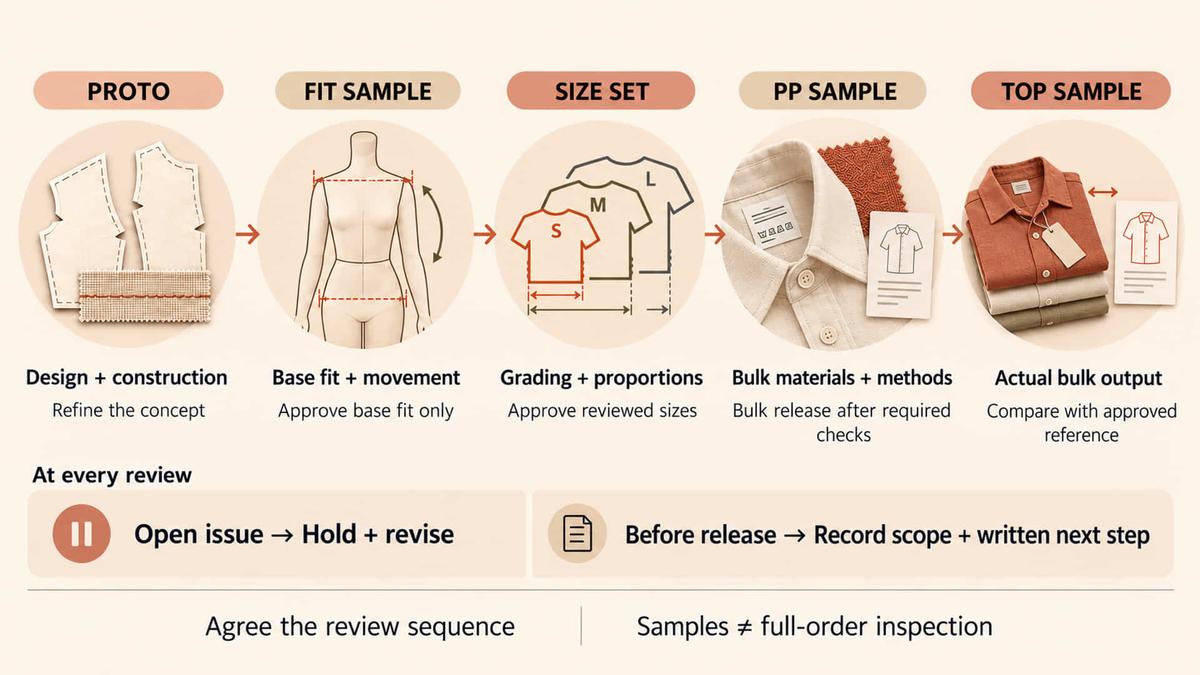
A prototype makes silhouette, proportion, and construction tangible. It may reveal a fastening that is difficult to reach, a collar that needs more structure, or an opening that does not behave as expected. Substitute cloth can support a limited construction review, but it gives weaker evidence about final drape when its weight, stiffness, or stretch differs from the intended material. Record that material status so the next reviewer knows what the sample can and cannot prove.
Structural decisions should be reasonably settled before detailed fitting begins. An unresolved fastening can change the opening, overlap, or neckline and force later fit work to be repeated. Aalix's article on the fashion design process explains how these decisions fit into the wider development sequence.
Fit Sample: Test One Defined Size and Body
A fit sample supports assessment of balance, ease, movement, and measurements in the size under review. A suitable form can help with static balance, but movement needs an appropriate wearer whose measurements correspond to the intended customer. For the trousers in the opening example, review both standing and sitting with the intended waistband position and appropriate underwear or layers.
Start by comparing actual garment measurements with the specification using agreed measuring methods and tolerances. If dimensions differ, check the pattern, cutting, sewing, and material behaviour before changing the fit specification. If the garment is made to spec but sitting remains uncomfortable, the patternmaker can investigate rise, crotch shape, ease distribution, and fabric response on the wearer. Widening the hip immediately may loosen the silhouette without fixing the real restriction. Review any correction under the same fitting conditions.
Fit Sample vs Size Set: Keep the Decisions Separate
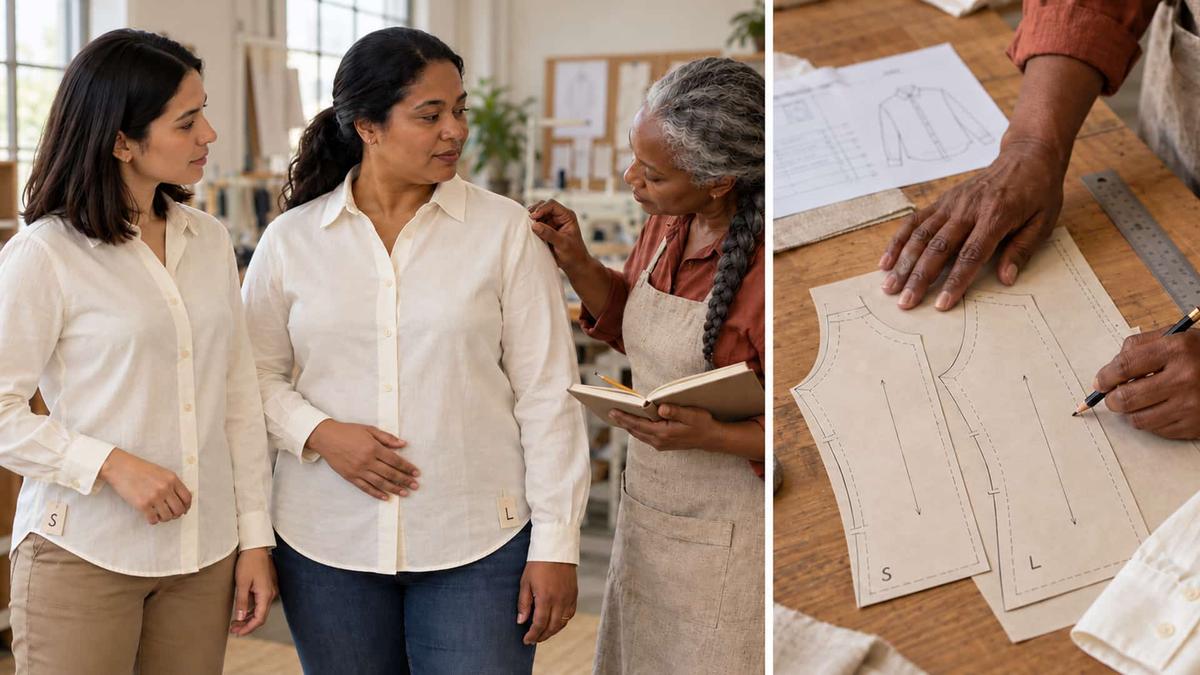
The fit sample vs size set distinction is about the scope of the evidence. A fit sample focuses on one submitted size, while a size set checks how the approved design and grade behave across the agreed range. Approval of the base size gives grading a starting point; it does not establish how the garment fits in every other size.
Check How the Design Changes Across Sizes
Suppose the base trousers fit correctly, but a larger size still restricts sitting even though its hip measurement is within specification. The grading and fit of that size need investigation. Changing the approved base pattern automatically could create a problem where none existed. Placement matters too: a pocket or fastening can become difficult to use even when circumference increases correctly. Use bodies or forms appropriate to the sizes being assessed, and use suitable wearers when movement needs checking.
Make Gaps in Size Coverage Visible
A full size set covers every size in the agreed range. A jump size set reviews selected sizes and leaves intervals between them. Agree the selection and its limitations with the supplier. New grading rules, a wider size range, or a close-fitting product may justify broader coverage. Sizes that were not reviewed remain gaps in the physical evidence, even when adjacent sizes pass.
For repeat orders, start with what changed. A new fabric can require renewed assessment of drape, stretch, and fit even if the pattern is unchanged. Added sizes require review of the extended grade. If both change, previous approval may leave both questions open. Reuse an old approval only where its original conditions still apply.
What a Pre Production Sample Must Establish
A pre production sample brings together the agreed production fabric, trims, construction, measurements, and finishing before bulk manufacture. Its purpose is to establish the manufacturing reference that production is expected to follow. Confirm which production methods it represents, including relevant machinery, seam construction, pressing, washing, and finishing processes.
Confirm Final Materials, Details, and Production Methods
For the trousers, the corrected pattern and final waistband components need to appear in the garment itself, not only in the tech pack. Approved artwork, labels, and placements also need checking. If a difficult operation was completed with special sample-room handling rather than the proposed bulk method, record that difference and identify what still needs validation. A carefully finished sample can establish a reference, but it does not prove that the production line can repeat the result consistently.
Check What Still Needs Production Evidence
A garment can pass fitting and still change after washing. Dimensional stability, stretch recovery, colourfastness, and seam performance therefore need checks appropriate to the product, with agreed methods and acceptance criteria. A passing fabric report does not prove how every assembled detail will perform. Resolve any conflict between the sample, specification, and test results before releasing the next manufacturing step.
Separate Presentation Samples from Production Approval
Some samples are made for sales, photography, or presentation rather than manufacturing approval. Their material, fit, and finishing status still need to be clear. Pins, temporary alterations, substituted trims, or image-only corrections can make a presentation sample unsuitable as a production reference. State whether the approval covers appearance only or any verified product properties.
Use Digital Samples for the Questions They Can Answer
Digital samples can support early proportion and design reviews when their inputs are suitable. Aalix's article on 3D garment visualization explains when that approach can help. Simulation can compare volumes and visual direction before sewing, but it cannot verify actual seam execution, physical handle, or behaviour after care. Keep physical testing for the properties a digital review cannot establish.
Use Top-of-Production Samples to Check Bulk Output
A top-of-production sample should come from actual bulk output. If it was specially remade in the sample room, it cannot show how the production line executed the approved construction. Compare identified production output against the approved reference and specification. Inspections and shipment release still need separate arrangements because a small number of reviewed garments cannot establish the condition of an entire order.

Turn Approval Comments into a Clear Release Record
Useful garment sample approval records connect a specific garment to a specific decision. Tags and comments should identify the style, version, size, material status, specification revision, reviewer, and date. Consolidating design and technical feedback also helps prevent contradictory instructions. Before sending the decision, make sure the record answers three questions:
- Which properties passed, and what work may proceed next?
- What remains open, who owns it, and what evidence will close it?
- Which reference garment and document revision must the factory follow?
If a replacement trim remains untested, the pre production sample has not received complete approval. The brand may accept specific construction details while explicitly withholding bulk cutting. State the missing evidence and name who can release the hold. A general 'approved with comments' is too vague when the supplier cannot tell whether production may proceed.
A detail mockup may demonstrate an isolated seam correction, but a change that affects balance needs assessment on the whole garment. Keep identifiable references with both parties where practical. After a change is accepted, update the controlling specification and identify the superseded version so a clear approval is not undermined by an obsolete production instruction.
Conclusion
Choose clothing sample types around the question the next sample must answer. Before commissioning it, finish this sentence: 'We need this sample to decide whether...' If the answer is only 'to check again,' define the unresolved issue and the evidence needed to close it. That discipline makes garment sample approval more useful: the team can choose the smallest adequate review, recognize when a complete garment is necessary, and avoid treating every sample as a general approval stage.
Frequently Asked Questions
What are the main clothing sample types?
Common samples include prototypes, fit samples, size sets, pre production samples, and samples taken from bulk output.
How does a fit sample differ from a size set?
A fit sample assesses one size; a size set examines grading across the agreed range.
Does an approved sample authorize bulk cutting?
Only when the written decision explicitly permits cutting and all required checks are complete.
Can digital samples replace physical approval?
Digital reviews support design decisions, but actual construction, material behaviour, and performance after care still need suitable physical evidence under the agreed testing conditions.