
A client asks to move a booking button just before a website launches. The edit sounds small, but the button sits inside a shared component, the mobile layout behaves differently, and testing is already complete. The useful question is not how quickly someone can move it. It is which decisions, dependencies, and checks the change will reopen.
A creative design change request checklist gives that conversation a practical structure. Clients need to know what they are authorizing, while studios need enough information to assess the work before production resumes.
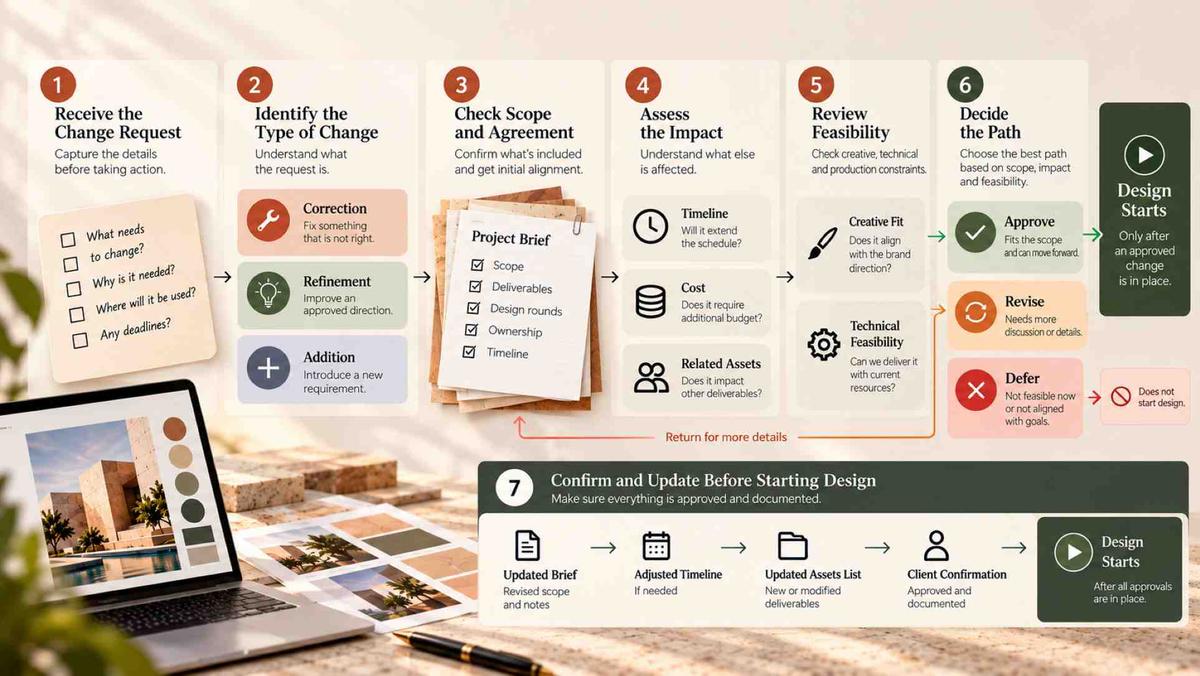
The aim is not to turn every revision into paperwork. It is to make the commitment clear: what is changing, why it matters, what else it affects, who can approve it, and what needs to be true before the request is considered complete.
Establish What the Request Changes
Start with the latest approved brief, deliverables, specifications, and recorded decisions. The creative project scope is the baseline for judging the request, including any revision allowances and exclusions. Compare the proposed change with that baseline rather than with how small the visible edit appears.
Separate Scope, Effort, and Payment
A correction brings an output back into line with an agreed requirement. A refinement improves an accepted solution. An addition introduces a new requirement or deliverable. A design revision request can involve any of these, but the label alone does not decide what the client should pay.
Keep three questions separate: does the request change the agreement, what effort does implementation require, and how does the agreement allocate that effort? Fixing a studio error may require substantial checking without automatically becoming chargeable additional work. A quick edit, meanwhile, can reverse an approved direction and fall outside the agreed revision allowance.
Use the checklist proportionately. A straightforward correction may need only a short record and a check of affected outputs. A request that changes audience, functionality, approved direction, or delivery commitments needs a more explicit assessment.
Make the Request Assessable
Describe the observed problem, where it occurs, the intended result, and any fixed requirement. If a reviewer proposes a solution, record it as a proposal unless it is genuinely mandatory. For more on framing the problem before prescribing a solution, see How to Give Design Feedback Without Diluting the Original Idea.
Define a Result Someone Can Verify
“Make the booking button more prominent” leaves several interpretations open. A clearer request identifies the affected page and device, explains the observed difficulty, and states the intended action. If there is no evidence yet, label the concern as a hypothesis and agree how to assess it before authorizing extensive redesign.

Acceptance criteria should describe the application and review conditions. For a button, that might mean checking the approved page layouts and confirming that the intended action is easier to find without competing with higher-priority content. Avoid promising improved conversion from a visual change alone; business outcomes may need measurement beyond design review.
Before choosing a response, confirm three things:
- Identify the approved version, requested difference, and evidence or requirement behind it.
- Trace affected outputs and estimate implementation, review, testing, and delivery effort.
- Confirm the authorized decision, accepted consequences, and criteria for completing the work.
Trace the Impact Before Offering a Price or Date
The visible file is only the starting point. A change may affect linked components, templates, formats, content, or another team’s work. In Digital Design and Branding, identity and interface decisions can extend across multiple applications. Follow actual dependencies rather than assuming either that everything must reopen or that the edit is isolated.
Include Work Beyond the Edit
An estimate should account for investigation, implementation, coordination, renewed review, testing, and export or handoff where relevant. State the assumptions as well. If the estimate depends on approved copy or a decision from another team, the date remains conditional until that input is resolved.
Scheduling also depends on capacity and sequence. Ask which planned activity would move if this request takes priority. A launch correction and an optional visual experiment may deserve different responses. The checklist should make that choice visible so urgency does not quietly transfer delay to another deliverable.
Where uncertainty is substantial, authorize a bounded assessment before authorizing implementation. Agree what the investigation should answer, who will review it, and whether the assessment changes any commitments. The result may be a recommendation to proceed, defer, or reject the request.
Several small requests can also accumulate into a larger change. Review their combined effect when they repeatedly touch the same approved direction or consume the allowance on which the schedule depends. There is no universal number that triggers reassessment; use the agreed limits and the emerging effect on the creative project scope.
Follow One Request Through the Decision
Consider a hypothetical website project with approved desktop and mobile layouts and completed testing. The client now wants a persistent booking button on mobile because the current booking action is hard to find on a long service page. This is a design revision request to assess, not an instruction to start editing immediately.
Compare Feasible Responses
The team first checks whether the problem can be solved within the existing layout. Moving an existing action may be enough. Adding a persistent component could introduce overlap with page content and require new responsive behavior. The assessment compares those options against the reported problem, affected pages, implementation effort, and remaining launch work.
Suppose the client selects the persistent component after reviewing those implications. A design change request form records the affected mobile templates, the chosen behavior, any agreed commercial adjustment, and the revised delivery commitment. It also states how the component will be checked. That makes the authorization specific enough for implementation and review.
The example does not establish a standard cost or duration. Its lesson is the sequence: inspect the problem, compare options, assess consequences, and approve one response. If the client wants the feature but has not accepted the scheduling effect, the request is still unresolved. Agreement about the visual idea is not yet agreement to proceed.
Record Authorization and Keep It Current
Use the creative design change request checklist to create a decision record that colleagues can retrieve. Capture the request identifier, requester, approved baseline, reason, selected response, affected outputs, responsibilities, consequences, and acceptance criteria. A shared ticket or short document can work; usefulness matters more than the software or the form’s length.
Distinguish the Approvals Required
The person approving design direction may not control budget or release timing. Establish which approvals the project needs and who holds each authority. A design change request form should distinguish reviewers offering advice from people accepting the relevant commitments. A general “looks good” should not be treated as approval of a fee or launch delay.
Give the request a status that reflects its actual condition: awaiting clarification, under assessment, approved, deferred, or completed. Record why it is blocked when necessary. Update or link the creative project scope to the authorized change so the original brief and later decisions do not become competing instructions.
If the requested behavior changes after approval, reassess the difference before continuing. Previous approval covers the recorded conditions, not every later variation. Update the record and confirm any changed commitments before work resumes.
Start Only When the Commitment Is Clear
At the final pre-work check, the team should know what is changing, what it affects, who has authorized it, and how the result will be accepted. Missing evidence may call for investigation; missing commercial or scheduling approval may block implementation. Name the unresolved decision and its owner instead of starting speculative production.
For a change close to release, agree what happens if verification fails. The team might retain the approved version or postpone the affected release, depending on the issue. That decision should exist before final testing, not emerge during it.
An approved design revision request still needs verification before closure. Check the intended result, dependent outputs, and delivery version. Aalix Studio’s Website Design and Development Process provides wider context for testing and handoff. Mark superseded files clearly, and make the approved outputs available to the people who will use them.

Conclusion
A creative design change request checklist is useful when it turns a request into a commitment everyone understands. Clear instructions are not enough if the affected work, delivery consequences, or approval conditions remain unresolved.
When those decisions are recorded, implementation can be planned responsibly. When they are not, the next task is to resolve the specific uncertaintynot to create another version and hope it becomes the right one.
Frequently Asked Questions
What belongs in a design change request?
Identify the approved version, requested difference, reason, affected outputs, decision owner, and acceptance criteria.
Does every revision require an additional fee?
No. Scope, implementation effort, and payment are separate questions. Check the agreement before treating a correction or refinement as chargeable work.
When should implementation begin?
Start after the selected response, affected deliverables, scheduling consequences, and necessary approvals are clear.
What if the request changes after approval?
Reassess the difference, update the record, and confirm changed commitments before proceeding. Previous approval covers the recorded conditions. Verify dependent outputs before marking the change completed.