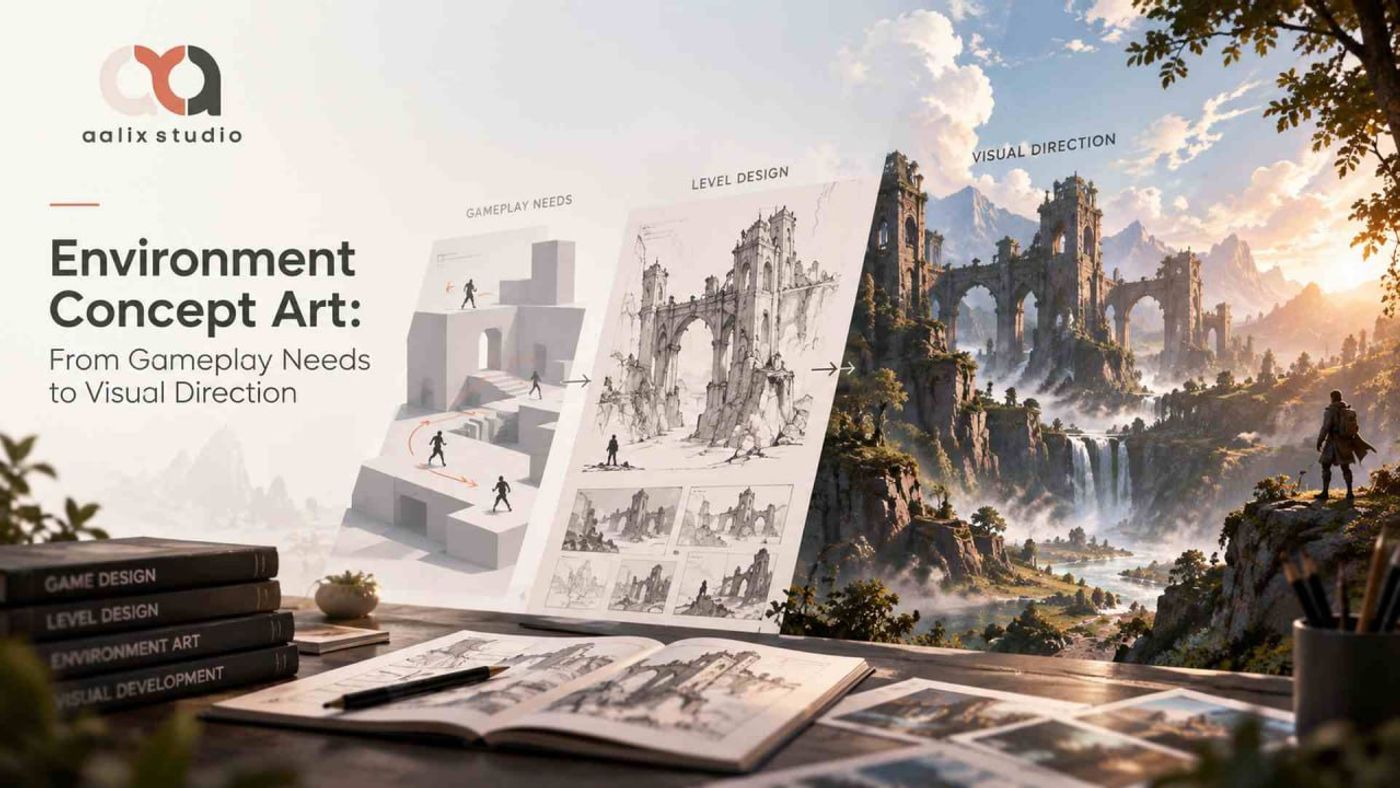
A beautiful environment image can still be a weak production concept. It may establish mood and look impressive in a presentation, yet leave the team with basic unanswered questions: where does the player go, which structures matter, what needs to stay readable during gameplay, and how much of the scene can actually be built?
Environment concept art should help answer those questions before production becomes expensive.
Its role is not simply to illustrate a place. It connects gameplay, level structure, narrative intent, visual direction, and production limits so that level designers, environment artists, technical artists, and outsourcing teams are working from the same assumptions.
The real value is reducing ambiguity early, before unclear decisions turn into extra geometry, materials, lighting work, or rework later in production.
The Playable Problem Comes Before the Picture
Environment concept work should begin with the playable situation, not an isolated image.
Before exploring architecture or atmosphere, the artist needs enough context to understand the camera, player abilities, critical routes, encounter type, target platform, and current production stage. A third-person exploration area creates different demands from a fixed-camera puzzle room or multiplayer arena.
This is where game environment design differs from illustration. A game environment has to remain understandable as the player moves through it, not just from one controlled viewpoint.
Useful inputs may include the greybox, top-down layout, gameplay capture, narrative summary, camera information, references, and technical budget. When concept work is outsourced, a clear game art production brief should also define required views, fidelity, review owners, and deliverables.
Constraints should be explicit. If the layout is provisional, say so. If a landmark cannot move because it anchors a gameplay objective, that should be clear before visual exploration begins.
From Blockout to Readable Visual Direction
Level design defines how the space functions. Environment art helps players understand that function through landmarks, contrast, silhouette, and visual hierarchy.
This is where level design concept art becomes useful. The concept should respect approved routes, metrics, and encounter logic while testing how architecture, terrain, lighting, and props make those decisions readable.
A blockout provides the spatial foundation, but the concept adds the visual language: recurring shapes, materials, construction logic, detail density, and environmental character.
The goal is not to decorate every surface. It is to establish clear visual rules that support gameplay and can be followed consistently by the production team.
For important views, reviewers should be able to identify the intended player action, the landmark or route that matters, and the visual cue that makes it readable.
Scale, Readability, and Mood Must Work Together
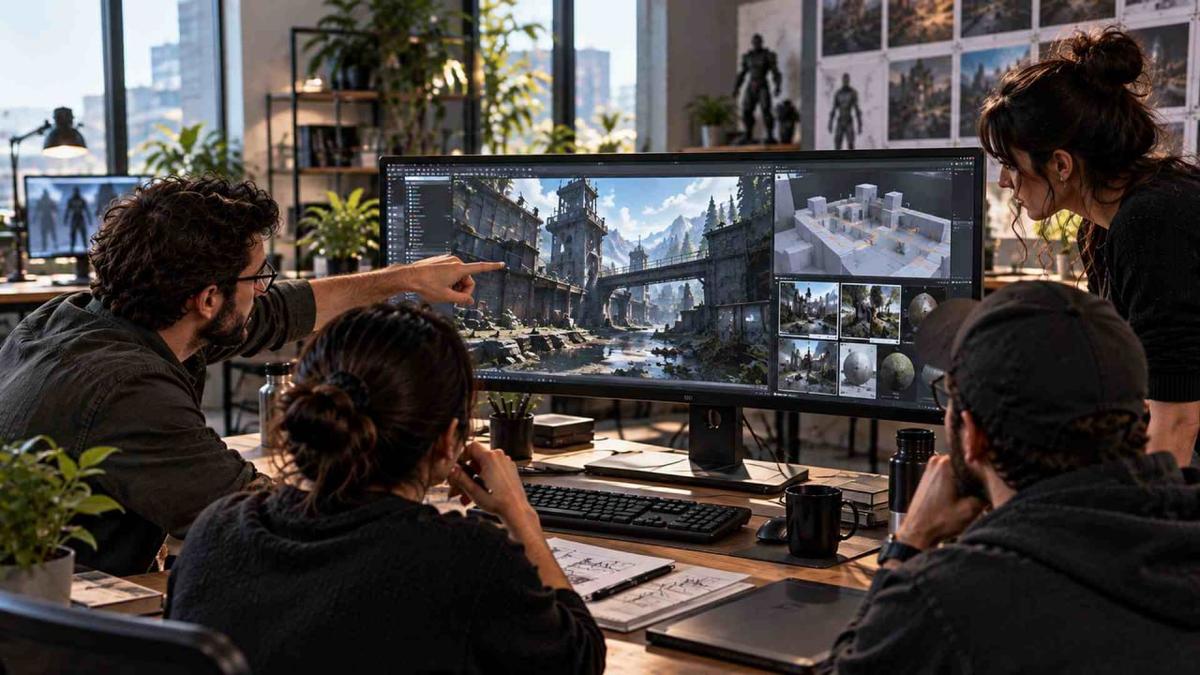
Scale needs clear visual evidence. Familiar references such as doors, figures, vehicles, or repeated structural elements help players understand the true size of a space.
The concept should communicate scale from the player’s point of view, not only from a cinematic camera. Landmarks and routes also need to remain readable when the viewpoint, lighting, or atmosphere changes.
Mood boards can establish color, material character, and lighting direction, but visual development for games becomes useful when those references are translated into practical rules for production.
If navigation depends on a landmark or route, its readability should come from structure, silhouette, contrast, and placement not only from dramatic lighting.
The same principle applies to architectural language. Shape families, materials, proportions, and wear patterns should feel consistent enough for different artists to build the environment as part of the same world.
A Game Concept Art Process Built Around Decisions
The game concept art process is rarely linear. A mechanic may change, a blockout may reveal a navigation issue, or a technical constraint may shift the visual direction.
The process stays manageable when each round answers a specific question. Early exploration should test a limited set of meaningful variables, such as landmark placement, architectural silhouette, enclosure, scale, or lighting direction.
If too many elements change at once, feedback becomes harder to interpret. The goal is to reduce uncertainty, not to polish every option.
Once a direction is approved, the artist can develop materials, construction logic, lighting intent, and environmental storytelling in more detail.
Feedback should also stay specific. A request such as “make it more epic” becomes useful only when it is translated into something actionable, such as greater scale, a stronger silhouette, a wider reveal, or a different relationship to the player.

Production Proof Matters More Than Surface Polish
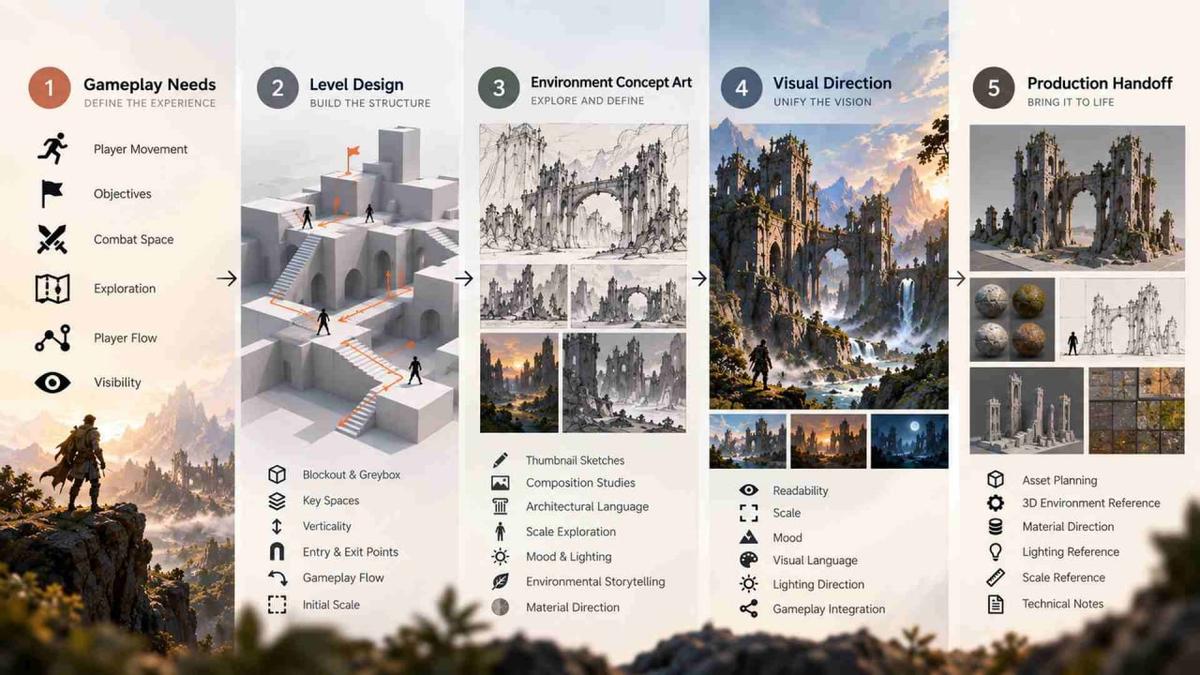
A final concept should give the next production discipline enough information to build from it confidently.
Depending on the scope, that may require orthographic views, material notes, modular breakdowns, scale references, dimensions, blockout paintovers, or alternate states. One cinematic image may work for a pitch, but it is often not enough for production handoff.
Clear annotations and documented game-ready asset requirements help reduce guesswork during modeling and set dressing.
Technical risks should also be reviewed early. Repeated architecture may need modular planning, transparent surfaces can affect performance, and dense areas may require material reuse or instancing.
The concept artist does not need to solve every engine problem, but the visual direction should respect the constraints that affect what can realistically be built.
Where Environment Concepts Create Rework
Rework usually starts when important decisions remain unresolved for too long.
A polished image can still hide problems with layout, scale, navigation, or technical feasibility. If those issues reach production, different artists may interpret the concept differently and create avoidable correction cycles.
Reviews are more useful when they happen during exploration. Level design can check routes and metrics, art direction can review visual language, and technical stakeholders can flag scope or pipeline risks before detail work becomes expensive.
The amount of detail should also match the milestone. Preproduction needs tested rules and representative targets; full production needs references specific enough for artists to build consistently.
For teams considering external support, Aalix Studio’s Game Art & 3D Assets capabilities show how concept work, environment art, asset creation, and art direction can connect within a broader production scope.
Conclusion: Align the Direction Before Production
Environment concept art is most valuable when it turns unclear production questions into visible decisions early.
Before approving a direction, check it against the blockout, gameplay requirements, visual rules, and technical constraints.
The next step may be a revised brief, navigation paintover, modular test, or technical reviewwhatever reduces the most uncertainty before production expands.
Once gameplay, visual direction, and technical reality are aligned, the environment team can build from a shared reference instead of interpreting the same concept in different ways.
Environment Concept Art FAQ
What should environment concept art clarify before production begins?
It should clarify gameplay priorities, navigation, scale, visual language, required views, and technical constraints.
How closely should a concept follow the level blockout?
It should preserve approved routes, metrics, and encounter logic while testing how architecture, terrain, lighting, and landmarks support readability.
When is a polished environment concept image not enough?
When production needs orthographic views, material notes, modular breakdowns, scale references, alternate states, or clearer handoff guidance.
What makes environment concept art production-ready?
It should communicate the spatial, visual, and technical decisions other disciplines need to build the environment consistently.