
A corridor kit may contain several doorframe designs with the same metal edging, while one damaged access panel carries a clue players need to inspect. The frames can share surface details, but repeating that clue throughout the corridor would defeat its purpose. For artists comparing trim sheets vs unique textures, that is the core decision: share details that belong to an asset family and keep local control for details that make one surface distinct.
Choose the method at the surface level rather than labeling an entire asset as a trim-sheet asset or a uniquely textured asset. Repeating profiles often suit trims, precise damage may justify dedicated maps, and broad uninterrupted surfaces may be better served by ordinary tiling materials. Camera distance determines how much detail must survive, while reuse determines how far the authoring effort can pay off.
Trim Sheets vs. Unique Textures at the Surface Level
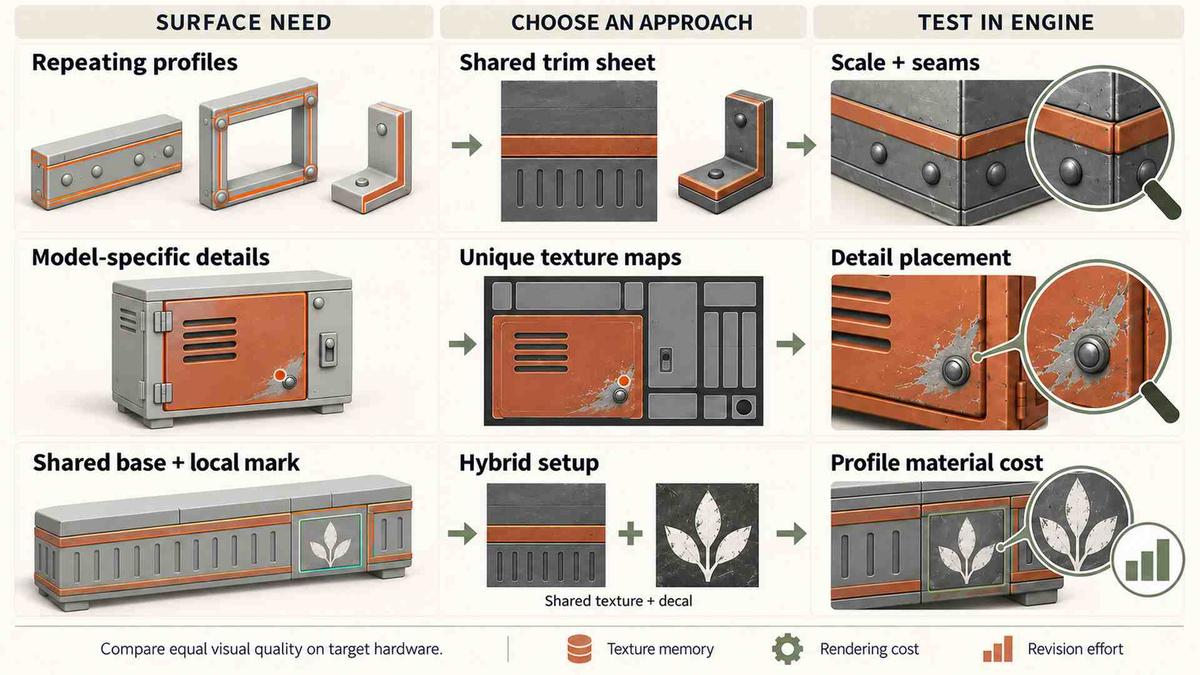
A trim sheet arranges reusable surface treatments into bands, commonly repeating along one axis. Mesh UVs - the coordinates that connect geometry to texture pixels - place selected faces over those bands. Different doorframes can therefore sample the same metal edge treatment without requiring a separately painted texture set for every frame design.
With unique texture maps, specific UV regions belong to specific parts of a model, allowing painted or baked information to follow its shape. Every instance of that model can still reuse the same maps. Dedicated texturing does not mean creating separate files for every copy placed in a level; the distinction is how texture space is allocated across different surfaces and models.
That distinction matters in game asset texturing because repetition happens at more than one level. Reusing one finished doorframe already reuses its textures, whichever method created them. A shared sheet extends reuse across different meshes, so its advantage grows when related designs genuinely need the same profiles.
Assign the Corridor Surfaces Before Building the Sheet
Imagine the kit needs narrow service doors, wider security doors, wall panels, and the damaged access panel. Before deciding between the two approaches, separate recurring construction details from information tied to a particular location. That makes it easier to see which surfaces can share a material and which ones need more testing before texture space is assigned.
Share Profiles That Actually Recur
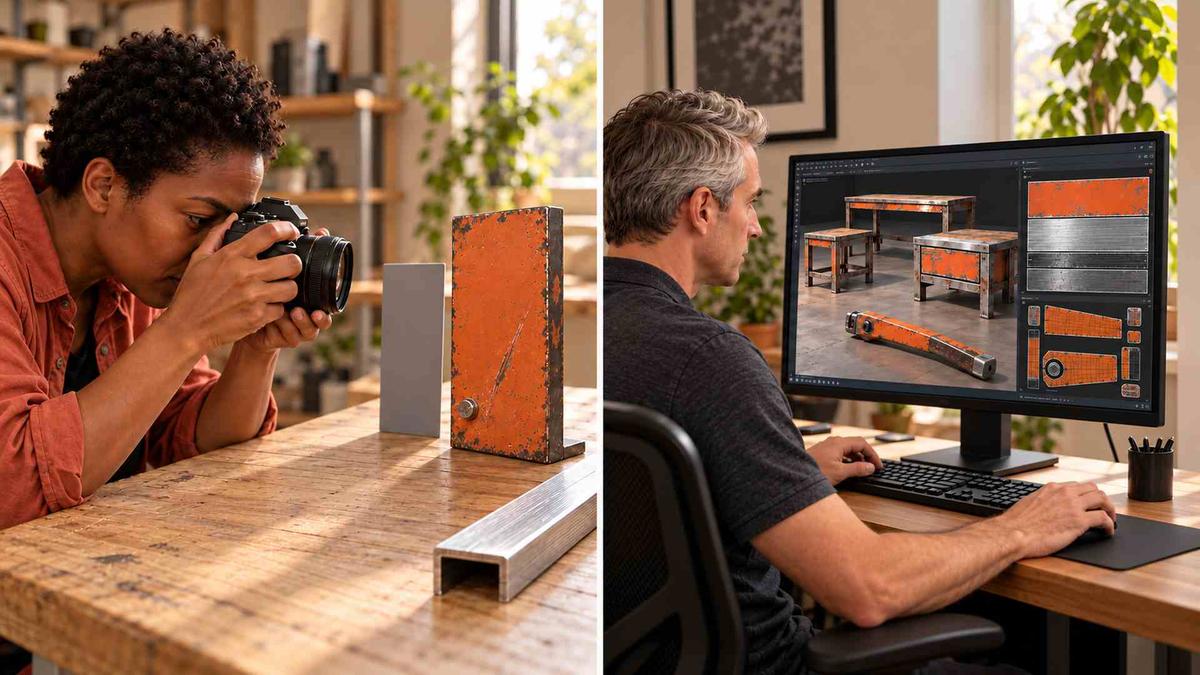
The doorframes can share bevel treatments and grooves if their proportions support the same bands. A useful trim sheet workflow starts with those representative shapes. Plan strip widths around the kit and leave room for treatments artists will repeatedly need. A beautiful sheet full of unused ornament still consumes authoring time and texture space.
Reserve Space for Information Players Must Read
Suppose the damaged panel needs scratches leading toward a specific screw and a burn mark crossing its recessed controls. Unique texture maps allow color, roughness, and normal details to line up with that layout. The case for dedicated maps depends on whether those relationships remain readable in play and how difficult they would be to reproduce through the shared material.
Let Broad Surfaces Tile
Uninterrupted wall panels may work better with a tileable painted-metal material, leaving trims for the borders. Stretching a narrow decorative strip across the whole wall would enlarge its details and constrain the design. Ordinary tiling keeps the wall independent of the edging proportions, so changing its dimensions does not automatically force a redesign of the shared strips.
Budgeting for Trim Sheets vs. Unique Textures
A trim sheet workflow moves more effort into planning and adaptation. Compare the time needed to author the sheet, fit every mesh's UVs, and test the assembled kit with the time required to unwrap and texture those designs individually. The second and later assets reveal whether the initial setup is actually paying off. A small family of unrelated shapes may offer little reuse even if the finished meshes appear many times in the level.
Corners expose costs that a straight frame can hide. A strip may stretch around a bend or break the direction of brushed metal. Extra mesh segments and UV cuts can restore control, but they also introduce editing work and boundaries to maintain. Geometry still has to preserve visible silhouettes; a normal map can suggest shallow grooves without replacing the shape of a projecting frame.
Texture limits should be agreed before the sheet is built. Aalix Studio's 3D production expertise covers materials, surface development, and engine validation - the stages that matter when checking whether a proposed allocation will work. If one exceptional surface needs sharper detail, compare a small dedicated set with the cost of increasing the resolution of every map in the shared set.
Across a kit, the decision should also account for the revision cycle. Changing a shared strip's roughness can update every frame consistently, while moving its boundaries can invalidate UV placement across multiple meshes. Once several assets depend on the sheet, freeze the layout or version any incompatible change, then test dependent assets before replacing the approved material.
Add Local Variation Only Where It Solves a Problem
The damaged panel does not automatically need dedicated maps for everything. Its outer frame might keep the shared trims while the control face receives local detail. In game asset texturing, a hybrid setup is useful when the exceptional area is limited and the extra material work remains manageable.

Distinguish Marks From Surface Reconstruction
A warning label or isolated stain may suit a decal if the target renderer supports the required channels and projection. A mask can control where material properties change, while vertex color can support broader variation where mesh density permits. An additional UV channel can provide local placement without replacing the shared base, although it adds another mapping requirement to maintain.
The decisive issue is the control required and the total cost of providing it. Complex recesses alone do not require dedicated maps. They become a stronger candidate when several model-specific effects need coordinated painting and the alternative depends on awkward projection, multiple overlays, or a shader the team cannot reasonably support.
A change in viewing conditions can also change the decision. If a background prop becomes inspectable, revisit its game-ready asset requirements before adding resolution everywhere. A clearer silhouette may require geometry; an unreadable marking may need redesign. Extra pixels help only when insufficient texture resolution is actually preventing players from seeing the required information.
Test Equivalent Results in the Target Engine
A useful comparison of trim sheets vs unique textures measures equally readable results under the same conditions. Use the corridor's intended camera distances, lighting, population of repeated assets, and target hardware. Keep unrelated scene settings fixed; otherwise, a lighter material may appear to win simply because its version omits damage or displays less detail than the alternative.
Set a texel density target, meaning texture pixels per unit of surface. For example, 128 usable pixels covering half a meter provide 256 pixels per meter in that direction. Verify both axes where stretching is possible. A strip can match the target across its width while looking distorted along its length, especially around corners.
At lower mip levels, smaller texture versions can reveal bleeding between neighboring bands. Padding and suitable UV placement help protect those boundaries. Along the repeating axis, the strip's opposite edges also need to join convincingly; padding cannot repair a discontinuous pattern. Test both conditions under the intended filtering settings, with camera movement and changing light exposing seams that a still image may hide.
- Confirm that frame details keep a consistent scale across straight and curved sections.
- Check that the panel's clue stays readable at the intended interaction distance.
- Compare runtime texture memory, rendering cost, and revision effort at equivalent quality.
Fewer texture files do not guarantee fewer draw calls. Material slots, instancing, and the engine's rendering path affect submission costs, while additional samples and overlays can increase shading work. Decal cost also depends on screen coverage and material complexity. Measure the complete setup instead of treating texture sharing as proof of faster rendering.
Runtime memory also differs from folder size. A shared set may serve many visible meshes, while dedicated sets introduce their own streaming demands. Loaded mip levels and the engine's memory budget affect actual residency. Record which visual requirements each version meets alongside the measurements so an apparent saving cannot hide a loss of necessary detail.
Deliver a System Another Artist Can Extend
Reliable game asset texturing needs more than exported images. Deliver editable sources, channel conventions, material dependencies, UV examples, and a representative approved mesh. Document which sheet version each asset expects. Aalix Studio's game art brief guide explains why technical requirements and acceptance criteria belong in the brief, where both the production team and reviewers can use them.
The handoff should explain which bands fit which profiles and show a solved corner. Another artist should be able to extend the approved trim sheet workflow without guessing how islands are scaled or where seams belong. Document exceptions separately so a special material or mapping requirement is not copied into ordinary assets that do not need it.
Conclusion
Before choosing a texturing approach for the full kit, test the surface most likely to break the proposed system. For this corridor, that means the difficult frame corner and the panel's coordinated damage. Approve unique texture maps where their control justifies the cost, and shared treatments where another artist can extend them reliably. Record what passed so the next asset begins with an established solution rather than another debate.
Frequently Asked Questions
When should I use trim sheets?
Use them for recurring surface profiles across different meshes, such as doorframes, beams, and panel borders.
When are unique textures more suitable?
Choose dedicated maps when an asset needs precisely placed, coordinated details that shared materials cannot reproduce efficiently.
Can one asset use both methods?
Yes. Shared trims can cover repeating sections while dedicated maps or decals handle localized details.
Do trim sheets always improve performance?
No. Compare runtime texture memory, material complexity, and rendering cost at equivalent visual quality on target hardware before committing to either method. Test representative assets inside the engine.