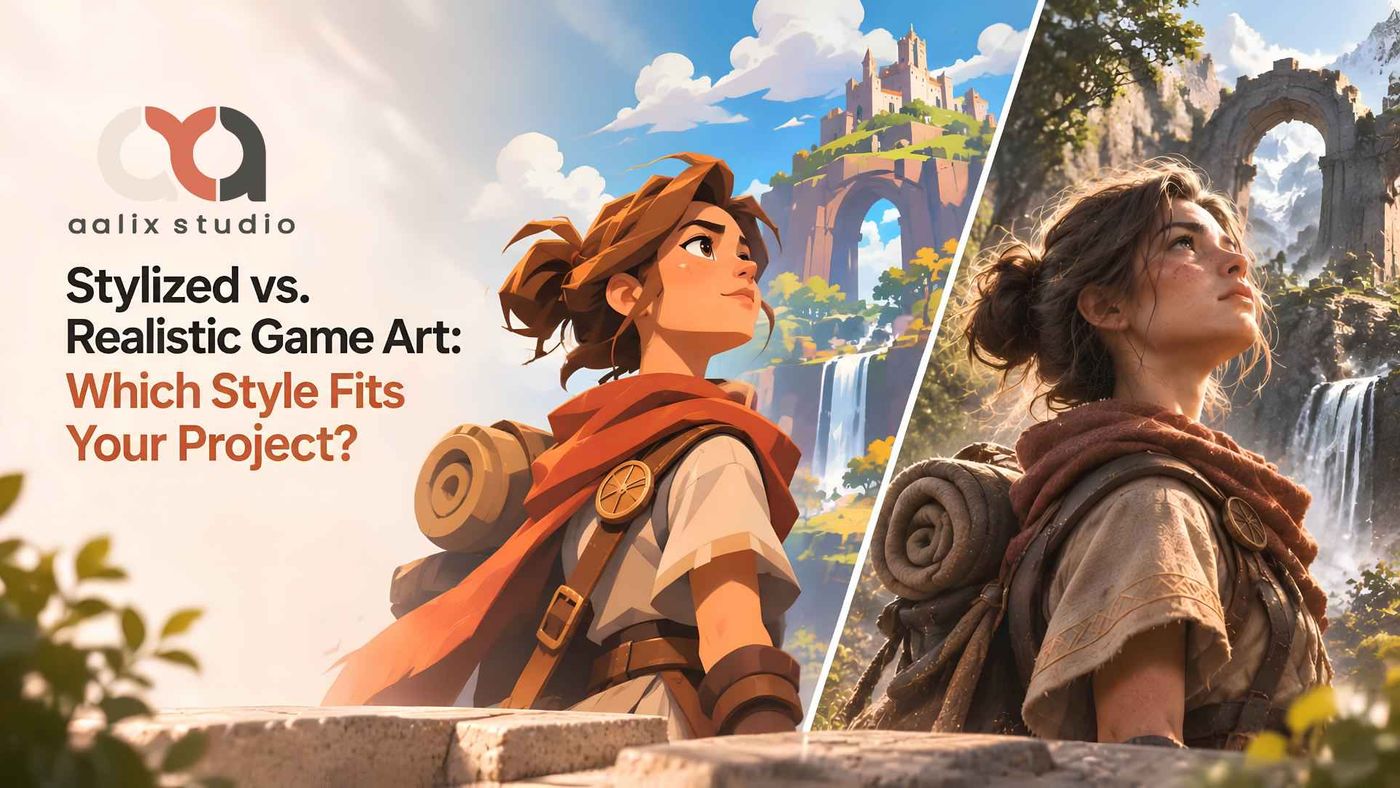
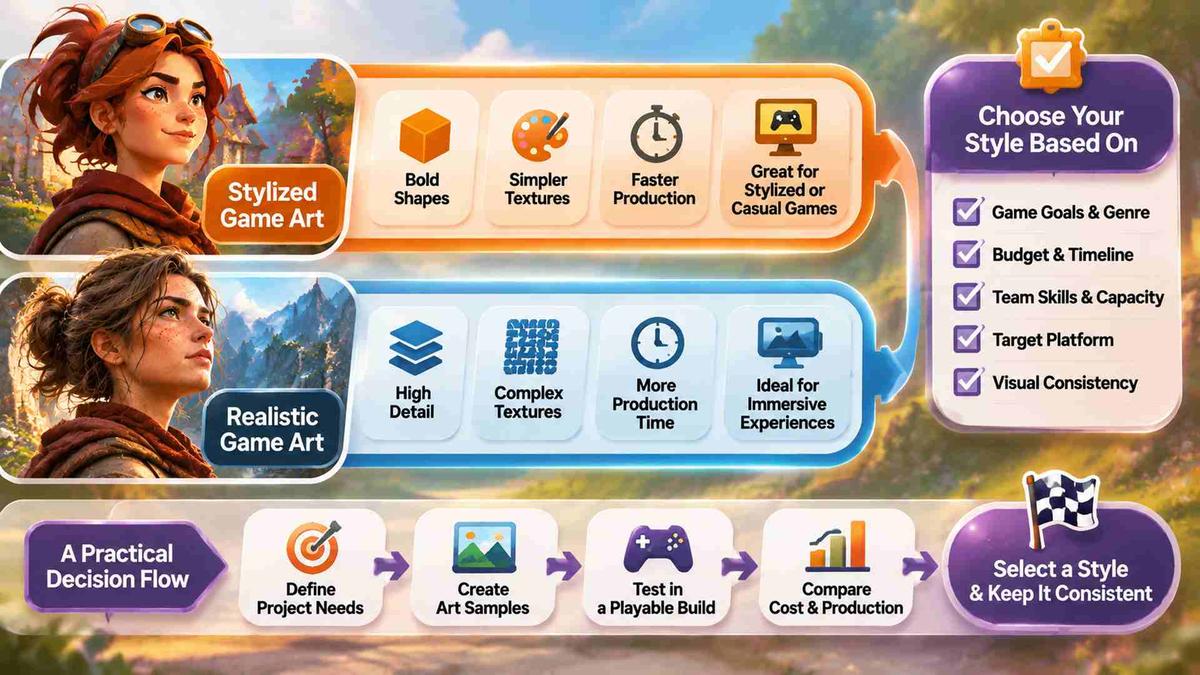
Two reference boards can win the same pitch meeting and demand very different games. Favor stylization when deliberate exaggeration strengthens recognition or expression and your team can reproduce its rules. Favor realism when familiar scale, construction, and material behavior carry the experience. A hybrid fits when those priorities need different treatments. The useful question in stylized vs realistic game art is which tradeoffs your project can sustain. Test that game visual direction against the gameplay camera, production capacity, and target hardware before committing to an asset library.
Separate Visual Style From Technical Fidelity
Stylized art deliberately reshapes reality through proportions, color, surface treatment, or lighting. Realistic art aims for convincing relationships between those elements, even when the subject is fictional. Neither label tells you the required asset resolution, animation quality, or production effort. A simplified character can demand careful sculpting and complex shading, while a believable background prop may need relatively little detail at its intended distance.
Treat stylized vs realistic game art as a spectrum of decisions rather than two fixed production packages. Physically based rendering, or PBR, describes how materials approximate light behavior; it does not require photographic shapes or colors. Stylized objects can use that material workflow too. Before choosing a game art style, separate shape language, material response, lighting, and detail density so artists know which qualities actually define the target.
Begin With the Camera and Player Action
A direction earns its place by helping the player understand the game. Consider a hypothetical cooperative adventure in which players identify equipment while moving through crowded spaces. Compare stylized vs realistic game art using that task, with the same camera distance and encounter layout. A dramatic character portrait cannot establish whether a small tool remains distinguishable during movement, or whether surface decoration competes with an interactive object.
Consider the emotional promise as well. Exaggerated proportions can support playful expression, but stylization can also create an unsettling world; believable materials do not automatically produce a serious tone. Show prospective players a short gameplay sequence and ask what experience they expect. If the art suggests precise physical simulation while the mechanics are deliberately loose, investigate that mismatch before treating visual preference as approval.
When Exaggeration Helps Recognition
Stylization can emphasize the feature that carries meaning: a broad handle, an angular shoulder profile, or a clear separation between an object and its surroundings. It is useful when players need to recognize roles quickly or when the fiction benefits from expressive distortion. That advantage disappears if every surface receives equal contrast. Simplifying shapes while adding busy effects can still leave the important action difficult to read.
When Believability Carries the Experience
Realism becomes valuable when players need to interpret familiar construction, physical scale, or material clues. In an inspection sequence, believable hinges and worn handles may help explain how an object works. It still requires selective emphasis. A plausible scene can hide a necessary control in shadow. The environment concept art guide provides useful context for connecting spatial cues with player movement before committing to detailed production.
Estimate the Work Behind the Look
Budget discussions about stylized vs realistic game art should start with representative assets and the people making them. Ask which tasks the proposed direction adds, removes, or makes harder to review. Include concept exploration, modeling, materials, animation, lighting, integration, and revisions. Comparing only modeling time misses the work needed to keep a character convincing in motion or to make a distinctive shading treatment behave across different environments.
Stylization Needs Rules Artists Can Reproduce
Stylized production can reduce surface detail, but it also asks artists to make deliberate choices about what to remove. An unfamiliar shape language may require more concept iterations than a familiar realistic object. The relevant test is whether the team can extend the approved game visual direction to ordinary props and secondary characters. A beautiful hero asset is insufficient evidence if every additional asset needs extensive art director intervention.
Realism Needs More Than Detailed Textures
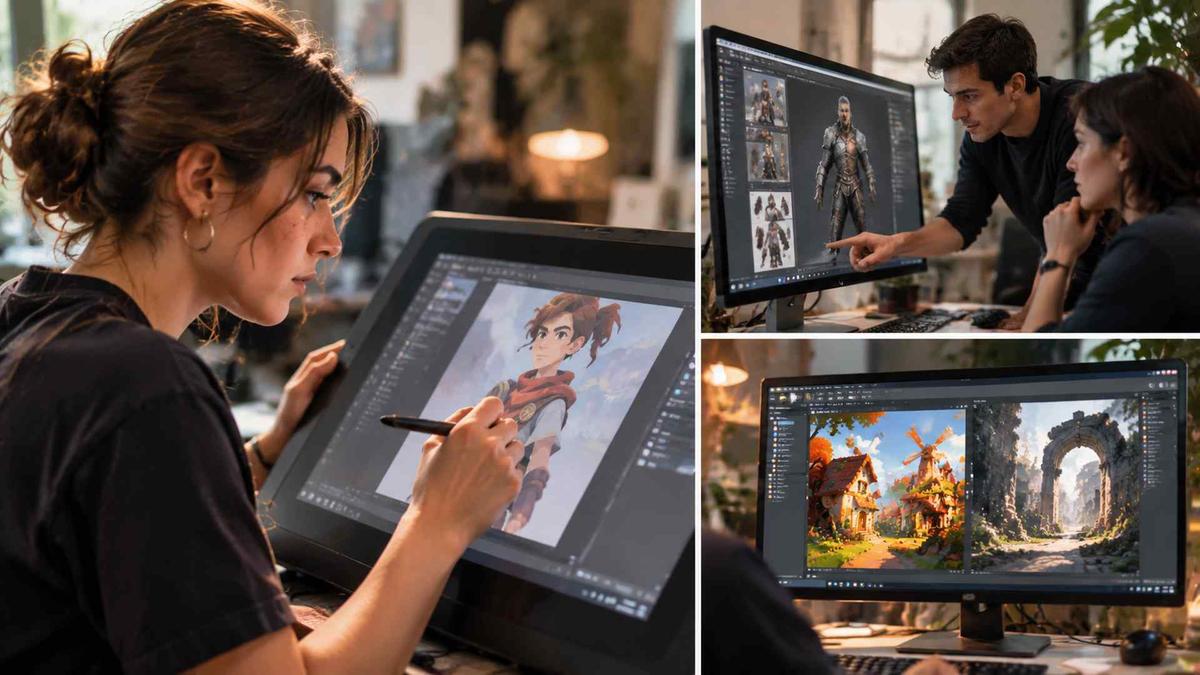
Realistic work needs relationships that remain convincing together: proportion, material scale, construction, deformation, and lighting. Adding scratches does not repair an implausible joint or poorly fitting garment. Aalix Studio's Ninja Character Design project documents sketches, garment development, modeling, materials, and preparation for animation. It illustrates the range of production stages involved without establishing that every realistic project needs the same tools, scope, or budget.
Team fit matters as much as the chosen target. Artists with an established realistic material library may work faster than they would with a new painted workflow; another team may have the opposite advantage. Estimate the cost of extending the sample across the asset list, including adaptation of purchased content and review of external work. Producing consistent game assets becomes expensive when each ordinary prop needs bespoke corrections. Later style changes can also affect approved models, textures, animations, and lighting together, so identify those dependencies before treating a change as a simple surface adjustment.

Measure Performance Separately From Appearance
The stylized vs realistic game art decision does not determine runtime cost by itself. Large transparent effects, demanding shaders, dense geometry, and expensive lighting can appear in either direction. Conversely, controlled material reuse and careful scene construction can support either look. Test the intended content on target hardware. A visually simple scene should not receive an automatic performance pass, and realistic surfaces should not be rejected without measuring their actual cost.
The chosen game art style also affects where compromises become visible. Reducing geometry may damage an exaggerated outline, while lower texture resolution may remove an inspection clue from a realistic prop. Review the visual loss alongside frame time and memory use. For immersive projects, test the actual headset and viewing distance as well. The decision should protect the cues players rely on, with technical limits agreed for the intended platform.
Define the Boundaries of a Hybrid Direction
Combining simplified proportions with believable materials can be a coherent choice. Calling the result semi-realistic, however, leaves too much unresolved. In stylized vs realistic game art discussions, specify what may deviate from reality and what must remain grounded. An oversized weapon might be intentional, while its grip still needs to fit the character's hand. Those boundaries should guide modeling and animation together rather than being decided separately by each discipline.
Write the game visual direction as visible examples and explainable rules. Show approved silhouettes, material finishes, color relationships, and acceptable detail density next to rejected alternatives. Explain why each alternative fails. Aalix Studio's Game Art & 3D Assets expertise places art direction alongside character, environment, and asset production. A project brief should make those connections specific, identifying the shared standards that each asset family must follow.
Preserve room for variation within those standards. A ceremonial object can be more elaborate than everyday equipment while sharing its world’s construction logic and material treatment. The goal of consistent game assets is recognizable belonging, not identical decoration. Assign one owner to resolve exceptions and keep the approved examples current. Otherwise, a hybrid can gradually become an accidental mixture as different artists interpret its boundaries differently.
Compare Playable Samples Before Expanding Production
Resolve stylized vs realistic game art with a bounded test. Start with the asset that carries the greatest uncertainty, such as a character whose expression depends on unusual proportions. Expand promising options into a small playable scene only after that first test. Record authoring time, review effort, and technical results as the sample develops.
For the hypothetical adventure, suppose a realistic tool becomes hard to identify at the gameplay camera while an exaggerated handle remains recognizable. First test whether a targeted shape or contrast adjustment repairs the realistic version. If it does, familiar materials and the team's existing workflow may justify retaining realism. If recognition requires distortion across the equipment set, a stylized direction may be more sustainable. This is a decision example, not a measured project result: the relevant outcome combines readability with the effort needed to reproduce it.
- Check whether players identify the required object or action from the intended camera.
- Measure the representative scene against the agreed frame time and memory budgets.
- Ask another artist to extend the sample using the supplied visual rules and references.
Agree on comparison conditions before polishing either sample. Use the same hardware, output resolution, player route, and action. Allow appropriate lighting for each direction, but document the differences. Set comparable effort allowances and record unfinished work. To test consistent game assets, include a second artist's contribution alongside the original sample.
Review failures before choosing a winner. If a prop disappears, identify whether shape, contrast, or lighting caused it. If another artist struggles, revise the guide and repeat that task. The game art style should earn approval through usable results. Retain gameplay captures, test conditions, and approved files as the review baseline.

Conclusion
Choose between stylized vs realistic game art by identifying which compromise the project can afford. Strong recognition may justify exaggerated shapes; close inspection may justify grounded construction and materials. When both directions work, compare the effort required to extend them across the planned content. Approve the option supported by that evidence, and document the unresolved exceptions before expanding production.
Frequently Asked Questions
Is stylized game art always cheaper?
No. Distinctive shapes, custom shaders, and repeated revisions can outweigh savings from simpler surfaces. Compare representative assets and relevant team experience.
When does realistic art make sense?
When familiar construction, scale, and material clues support the intended player experience, especially during close inspection.
Can both styles share one project?
Yes. Define which proportions may exaggerate reality and which material or construction rules must remain consistent.
How should teams approve a direction?
Test representative assets during actual gameplay on target hardware. Compare readability, production effort, performance, and another artist's ability to reproduce the approved look.